

As corporates look to separate AI hype from real-world trade finance applications, GTR spoke to the teams at Siemens Healthineers and Komgo to explore how AI is being used in practice.
“We began with a problem,” says Tim Bachinger, head of trade finance at Siemens Healthineers, describing the firm’s foray into using AI tools in its live operations.
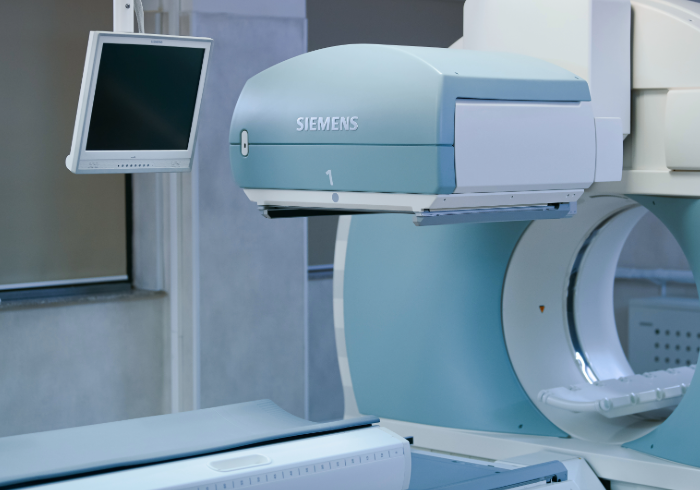
The medical technology company, which started its spin-off from Siemens with an initial IPO in 2018, produces imaging systems like MRI scanners and X-ray machines, tools for cancer care and lab diagnostics equipment.
Healthineers sells this big-ticket equipment worldwide, largely to public-sector hospitals, and it relies on trade finance tools such as guarantees, letters of credit (LCs) and supply chain finance to win and deliver on public procurement contracts.
Its trade finance team had been working with Geneva-headquartered fintech Komgo – which digitalises and automates trade finance operations for financial institutions and corporates – since 2021 to bring in automation capabilities and implement the Swift communication channel.
Komgo, which was founded in 2018 by a consortium of banks and commodity traders, had last year introduced a suite of AI-powered capabilities under its Global Trade Konnect (GTK) application.
At the time, the fintech’s chief executive, Souleïma Baddi, said the aim was to combine “the best” of Komgo’s solutions into one application.
GTK includes three generative AI tools that incorporate document analysis: its LC creation agent, which automatically creates draft LCs from invoices or purchase orders; a digital reporting assistant that can respond to questions and query large datasets; and a smart clause checker, which compares new LC clauses against internal policies to flag any potential issues.
So around 18 months ago, Healthineers and Komgo went through a detailed process of identifying where and how the fintech’s new generative AI tools could best be used.
The medtech company was the first Komgo client to use the AI-enhanced capabilities brought in with GTK, and the two firms set off identifying three use cases where they could potentially add value.
The team had a “strong need for digitalisation, automation and efficient workflows”, Bachinger says. The next question Healthineers asked was, could AI really help?
Productivity gains
Working with Komgo, Bachinger says the two firms “co-innovated”. From Komgo’s perspective, Healthineers had the right profile, with specific pain points to address and the potential to scale up the solution.
“AI is particularly relevant in areas involving high transaction volumes, multiple banks and the ability to deploy software broadly to solve real operational challenges,” explains Tim-Emilien Tran Ngoc, Komgo’s APAC managing director.
Chief among these pain points was the potential to save significant amounts of time, particularly in the case of treasury analytics.
“One key problem was productivity. How much time are we wasting a month, for example, with basic reporting?” says Bachinger.
To address the reporting use case, the Healthineers team now uses the digital reporting assistant built into the GTK application.
This tool, Bachinger says, has removed “a lot of activities that are very manual”. As well as saving time, this means fewer errors and better decision-making, he adds.
“You can type in basic questions, such as ‘give me the list of guarantees from India for the past year’, or ‘how has bank X been performing over the past six months, and what is the average turnaround time’, so it can give insights on that,” says Avinav Thakur, general manager, treasury at Healthineers.
Crucially, it means Healthineers can be far more proactive when staff go to meet banks, quickly gathering data on, for instance, a lender’s guarantee turnaround times over a specific timeframe.
“We can also ask the AI what it would suggest based on the current performance of a bank, such as headroom or fees, should we route the request to a different bank and so on,” says Bachinger.
“We still make the decision, but it’s an interactive and real-time tool that we are using that supports data-driven allocation and bank relationship decisions in order to make use of the data that is available.”
Automation and generation
As well as reporting, each year the company has to turn around thousands of new bid or performance guarantees for public customers.
The team operates within tight deadlines for delivering guarantees for public customers, which can be anything from five working days to the next day, across multiple international markets and banking partners.
This was often a stretch for its relatively small team, Bachinger explains, and represented another potential area where AI could be used.
A further problem was that many guarantees have non-standard wording, which the Healthineers team has to vet.
“We have to verify whether the clauses have any risks, and whether they adhere to the internal guidelines or violate them. That is a purely subjective task,” says Thakur.
“We explained to Komgo which clauses could pose a risk, or violate any internal guidelines, and based on that, Komgo used AI to train the system to spot these clauses, classify them as high risk, medium risk, and the reason why, as well as suggest alternative wording.”
With LCs, Thakur explains that business users typically provide the underlying document or a contract, and then ask for an LC draft.
“We had to go through the documents – and the documents could be in a variety of formats, depending on the countries we’re dealing with – to pick up the key fields and prepare a draft,” he says.
The business user would then receive a revised draft from the bank, and share it again with Healthineers. “We have to compare what the bank gave, what we gave, and that takes two or three rounds. The process was completely manual for us,” says Thakur.
For this use case, Healthineers wondered if it could save time and minimise risk by extracting key terms from the underlying documents used to prepare LC drafts, using Komgo’s LC creation agent.
Working together, the firms developed a process whereby Healthineers could upload the underlying document and the AI system then draws out the key fields, regardless of format, using document understanding.
“We also needed a way to link the new draft, so that we could compare both versions,” which Komgo provided, Thakur adds.
So far, the results look promising. Early estimates indicate potential savings of some 600 to 800 hours of work per year, the firms say.
The future is agentic
Throughout the development of these solutions, data privacy has been a key focus.
“Data privacy compliance and third-party vendor compliance was very important, and being able to restrict user access to certain users or countries – this was on the agenda on day one,” says Bachinger.
There are “four pillars” any new solution must comply with, Tran Ngoc adds – “it must be secure, reliable, scalable, and affordable”.
According to the fintech, “Komgo’s embedded AI approach operates within a controlled, enterprise-grade framework”.
Overall, Bachinger says that the teams have worked on the pilots and live operations with “a lot of passion and a lot of drive”.
It was also vital to get buy-in from upper management, he says, noting that part of the argument was that there is strategic value in being an early adopter: “I would rather be at the forefront in shaping and building it.”
Tran Ngoc points out that risk reduction, through removing errors and enabling greater proactivity, is another advantage that benefits “the entire trade finance ecosystem”.
“We are all interconnected, so when one participant becomes more efficient and manages its risks more effectively, everyone benefits,” he says.
Looking ahead, Bachinger says agentic AI could well be the next step, after digitalisation and generative AI.
“This is a bit farther away, but if Healthineers has an agent, Komgo has an agent, and the bank has an agent, they can communicate for most routine activities, especially low-risk processing,” he explains.
“We do not see agents replacing trade finance experts, but acting as intelligent digital co-workers that automate routine work and provide recommendations while humans remain in control of decisions.”