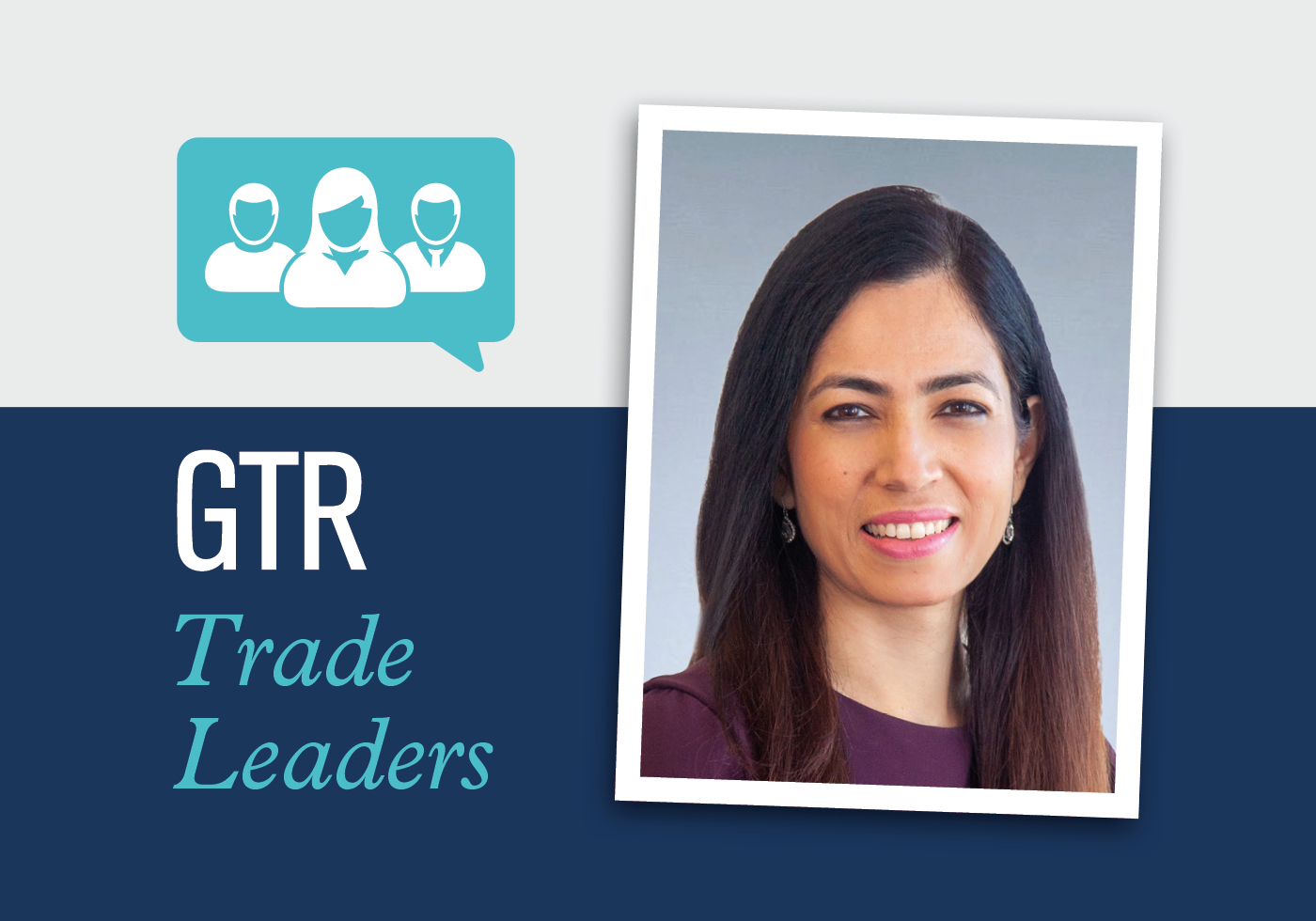

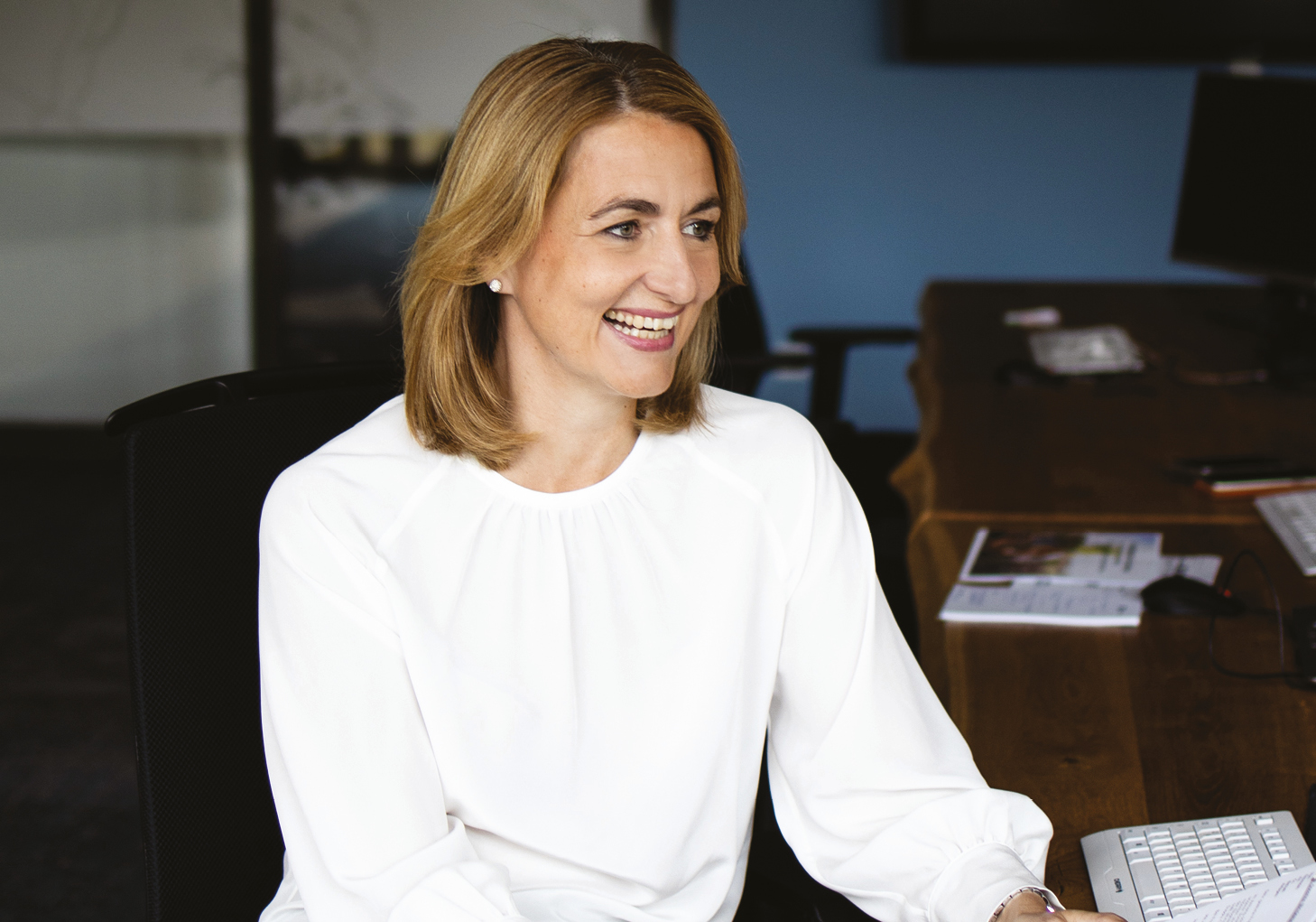
The chief executive of Euler Hermes, the German export credit agency, talks about Team Europe, tackling Germany’s economic headwinds and her interest in leadership psychology.
Edna Schöne loves the twice-yearly get-togethers of EU export credit agency heads so much partly because the visits are an opportunity to “see how beautiful Europe is”. It’s easy to see why the chief of Euler Hermes – whose favourite city in the world is Stockholm – has adopted the mantra of “Team Europe”, a concept heard more and more in the continent’s export finance community.
Big European economies like Germany, the UK and France face a tricky trade future: many of their historic advantages are being eroded by China’s ever-growing technological know-how, while labour and energy costs are rising.
With trade policy already heavily influenced by Brussels, this has led to the understandable conclusion that joining forces might help European companies of all national origins win export contracts overseas.
“The idea of Team Europe, in my view, is not to replace what we are already doing on a national level because there are very good ECAs and national tools in place. It’s to scale it. It’s to upgrade it in situations where you need to be competitive compared to others, and I think everybody buys into that idea,” Schöne tells GTR.
European ECAs have long co-operated to some degree. They often reinsure each other’s exposures when capacity is stretched, or join forces on some big-ticket projects that need exports from more than one country.
In the last four to five years, Schöne and her counterparts have met twice per year in different European locations to get to know each other and build trusting relationships, at what is dubbed ‘The Summit’.
“You can ask yourself ‘oh my God! 27 years at an ECA; why would you stay that long in one field?”
A suggestion they ditch one of the two in-person meetings in favour of a logistically easier virtual gathering was dismissed by the cohort.
But in addition to the friendly confabs, a greater desire to formalise co-operation in export finance is also emanating from Brussels. For the last several years, the European Investment Bank (EIB) has been crafting a package of trade and export finance support measures that look likely to heavily feature a reinsurance mechanism.
Schöne took the stage at an EIB event earlier this year to call for a quick and “unbureaucratic” roll-out of the scheme. Countries including the Czech Republic, Denmark, Slovakia and Sweden are all on board for what will be some kind of pan-EU export credit function, albeit not a full-blown agency.
But the EU’s 27 member states, especially the major economies, all want to secure exports and employment. Sometimes, doesn’t that have to come at the expense of their neighbours?
“We can be competitors,” Schöne says. For example, a Global Gateway project might attract bids from Italian, French, German and Dutch companies, all capable of carrying out the work. In that situation, she says, “may the best win”.
Euler Hermes, a division of commercial insurer Allianz Trade, has a contract to service the government’s federal export guarantee programme and acts as its export credit agency. It has decision-making authority for some transactions, while for others, the government has final authority. Questions of policy and strategy are decided in conjunction with Berlin. The business has its own staff, IT infrastructure and legal team from Munich-headquartered Allianz Trade. Allianz Trade was known as Euler Hermes until 2022, but the entity that acts as the German ECA retained the original name.
27 years at an ECA
Yes, there is also a Team Germany. And Schöne has been a member since 1999, when she joined the Euler Hermes graduate programme after law school and never left.
“Being an intersection of economy, politics, international cooperation, and also having really an impact as you can have when you are working in an ECA – I think that’s what’s making most people love what they do and stay a long time in this community. That was true for me as well.”
“You can ask yourself ‘oh my God! 27 years at an ECA; why would you stay that long in one field?’ And I think what’s intriguing with these export credit agencies [is] that you have to reinvent yourself along the way because politics changes, geopolitics changes – as we can definitely see right now – and that means you need to adapt.”
Her first foray into leadership came in the mid-2000s, a period when worries over global warming had begun to galvanise public attention. For ECAs, that was reflected in an acknowledgement of the profound environmental and social impacts sometimes caused by the projects they supported.
“The awareness was really growing that we need to take more responsibility not only for economic effects but also for environment and social effects,” Schöne says. So, she made a proposal: Euler Hermes should establish a sustainability department, with a team that specialised in the topic. The proposal was accepted, and she became head of the sustainability department in January 2006. “That was my first leadership position, which I created on my own.”
Just under 10 years later, in 2015, Schöne was appointed to lead the organisation she had joined as a graduate in 1999.
Meeting the moment
Today, Germany remains the exporting powerhouse it was back then. It sells the third-most goods and services in the world, after only China and the US. Its nearest European rivals do not even come close. The ECA’s volumes reflect that: last year, it retained its position as the world’s fifth-largest provider of export credit cover.
But renowned German industry is having a crisis of confidence over competition from Asia – chiefly China – where many of the German Mittelstand’s traditional output can be made more cheaply. And China is closing in on quality as well, with improving technical know-how to manufacture the precision-engineered products Germany has long been famed for. Underlining the turmoil in the country’s auto sector, Volkswagen’s chief executive said in July the car company’s worldwide job cuts could reach 100,000.
But Schöne believes the country’s ECA is rising to the moment.
In the last two years, it has refreshed its product line-up, introducing two more nimble support options – flex&cover and a shopping line cover – that make it much easier for companies to qualify for government guarantees. Last year, the government supported €1.7bn in financing under flex&cover. It has also eased long-standing curbs on the defence industry. Many other European ECAs are doing the same, while their counterparts in Asia have had similar structures in place for years.
But Schöne says it has been a “big change” for Germany. And she believes that the increased flexibility reflects a new mindset replacing the long-standing perception of ECAs as simply filling a gap in the commercial insurance market.
“This insurer of last resort [concept] is evolving towards becoming something like a market maker. That’s very, very different to when I started 27 years ago, and that means it’s kind of even a different philosophy. You need different skills. You need to build up long-term partnerships.”
By market-making, she means helping generate appetite for German goods in export markets. That is partly done by having people in key markets, such as Turkey and South America, touting German suppliers. It is a model also adopted by other ECAs.
“This insurer of last resort [concept] is evolving towards becoming something like a market maker.”
“Before… I was very much spending time in the German market with our clients, which are the German exporters and the financing banks. That, of course, we still do, but we have added to that that we are building partnerships with buyers all over the world, possible buyers of German equipment. We have to be present there in order to build trust, make them understand how it works.”
Markets with Team Germany export credit representatives include Turkey (currently Euler Hermes’ largest market), Dubai, Singapore and Côte d’Ivoire. There is also a roaming representative travelling through the major markets of South America.
But last year, despite the new products, the total value of cover issued by the agency slumped by almost a quarter to €13.3bn, according to the ECA’s annual report. It said that was mostly due to the closing of big-ticket projects being pushed into 2026. Offers totalling €17.5bn were made last year for deals still being negotiated and Schöne says she expects this year’s figures to be strong.
“I believe that the expectation is that we, as an export credit agency, do what we can to support the German exporting community, which is really very challenged in many ways,” says Schöne. “But one also has to say, [we] have a lot of companies which are thriving, which have been our customers for decades, and they still have a very good business model.”
Leadership psychology
And Schöne is very familiar with German corporate life. Her CV lists positions on supervisory and executive committees and boards at entities including energy transmission operator TenneT, KfW-Ipex Bank, and a swathe of industry associations, including the International Chamber of Commerce and the German Business Association for Latin America.
It’s less surprising, then, that when asked to describe how she spends her non-working hours, her answer is very boardroom appropriate. Apart from spending time with her son’s dog, Muffin, she also provides executive coaching, having completed a training course a couple of years ago, and has an interest in leadership psychology.
Coaching others has also led to some valuable lessons of her own, she explains. “It has helped a lot in my leadership role because it takes a little bit away from this, well, directness sometimes, which you might need to have.”
“How can I actually not tell people what to do, but enable them to be their best self?”
Getting personal
What’s a book you recommend to people?
Patrick Lencioni’s The Five Dysfunctions of a Team. It fundamentally changed the way I think about high-performing teams – and about leadership.
Favourite breed of dog?
Miniature poodle. Small dog, huge personality. Muffin is technically my son’s dog, but somehow he has managed to become the centre of the entire family.
Is there a goal you’re most proud of achieving?
Raising my son, mostly as a single working mother. It taught me more about resilience, love and perseverance than anything in my professional life ever could.
What would you be doing if you hadn’t pursued a career in export credit?
Opera singer – that was the original plan. Today, I’d choose psychology. I’m fascinated by what happens when you ask the right question rather than give the right answer.
If you could add or delete one provision to the OECD Arrangement with no negotiation, what would it be?
I would not add or delete a provision. I would be tempted to start again from scratch – and ask what an Arrangement designed today would look like.
If you could be the head of any other ECA, which one would you pick?
I’m too attached to Germany, its economy and the people I work with. So I’m afraid I’m not available on the ECA transfer market!