

Ukraine’s reconstruction cannot wait for a ceasefire, say those on the ground – and it increasingly isn’t, as banks, insurers and export credit agencies finance the rebuilding of its infrastructure despite the ongoing fighting. But four years into the war, the country is still struggling on two fronts: raising the finance its recovery requires and earning investors’ trust along the way.
When Russia launched its full-scale invasion of Ukraine in February 2022, family-owned Kormotech – one of the country’s top pet food makers and exporters, selling in over 50 countries – halted production.
“We were afraid about our people, so it was a security question,” co-founder Rostyslav Vovk told the European Bank for Reconstruction and Development (EBRD) Annual Meeting audience in Riga this June.
But just two days after closing, the company’s staff regrouped, splitting its operations into three equal units: Ukraine production, European exports and a charity for abandoned pets. “There was no CEO, there was no chief supply officer, everybody was on the same level,” Vovk said.
Kormotech quickly pivoted and opened a logistics hub near Kraków, outsourcing production to “friends and competitors” across Poland, Belgium and Lithuania. Four years on, the company is targeting a tenfold rise in export revenue, from €30mn to €300mn, by the decade’s end.
Its story is just one example of the tenacity that has come to define Ukrainian businesses operating amid a war that has no real end in sight.
“There is no reason for anybody to wait for anything for after the war,” Tomas Fiala, CEO of investment bank and financial services company Dragon Capital, told the same Riga event. His firm’s US$250m Rebuild Ukraine Fund, backed by US$25mn apiece from the EBRD and the International Finance Corporation (IFC), reached first close in January.
“You have to do things now,” he said.
It is a plea echoed by Ukraine’s finance minister, Sergii Marchenko, who conceded that the government has had to make “difficult decisions” and often prioritise defence and security amid “scarce” public resources.
“Our biggest concern right now is capacity to direct finance to our needs,” Marchenko said at the EBRD event, highlighting the urgent need for financing in public services, particularly in sectors such as rail and energy.
“We can’t wait.”
The financing gap
The stark gap between Ukraine’s financing needs and the capital available for rebuilding makes clear how scarce those resources are.
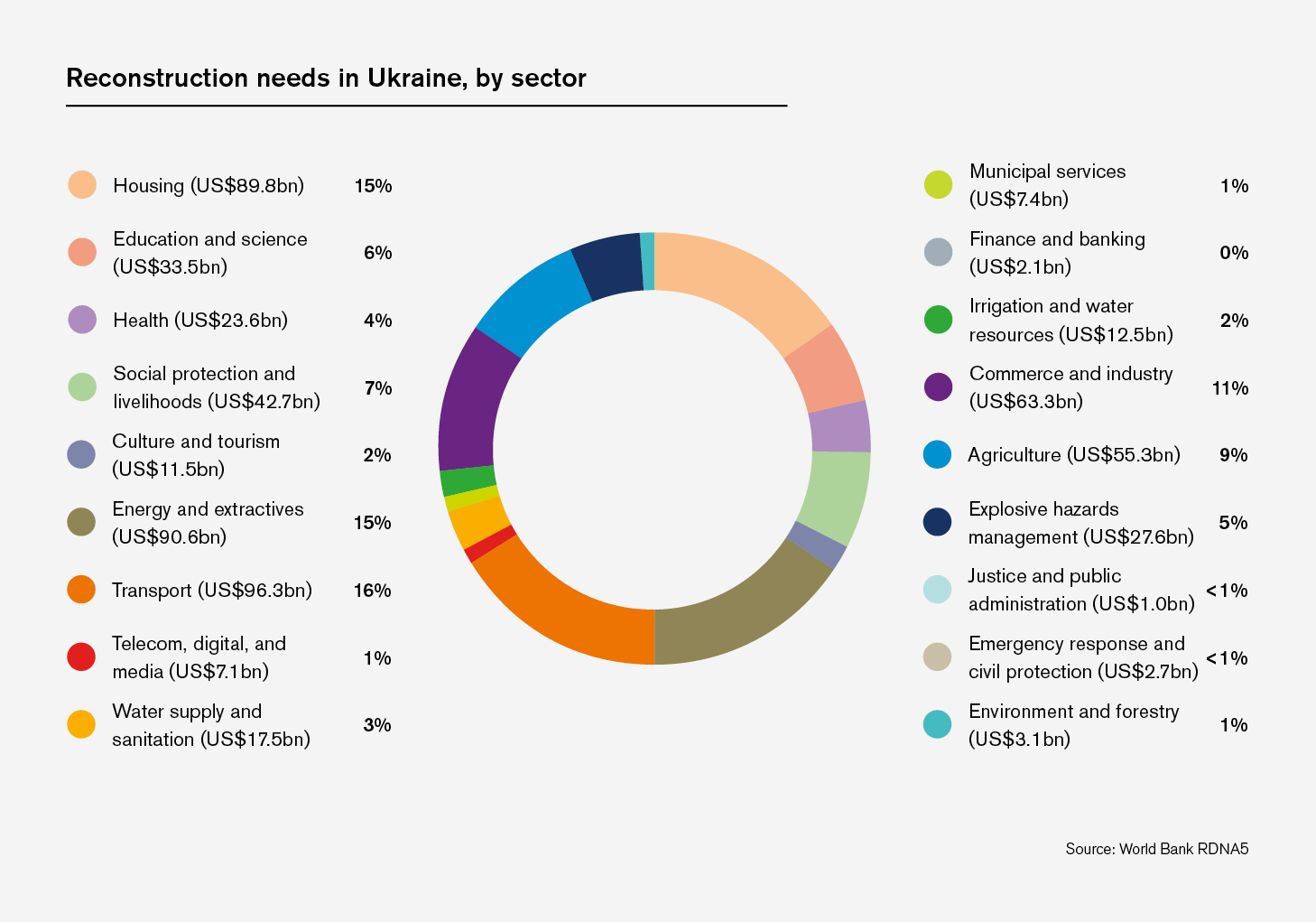
The World Bank’s latest damage assessment puts Ukraine’s reconstruction and recovery needs at US$588bn over the next decade, almost three times the country’s 2025 GDP. Meanwhile, the OECD estimates that priority recovery needs for 2026 alone amount to US$15bn.
Efforts to direct funds towards crucial sectors are already underway. Ukraine’s 2025 budget allocated Hrn224bn (roughly US$5.4bn) to 93 projects, with the transport and energy sectors absorbing around 65% of the total.
Targeted commitments from partners at this year’s Ukraine Recovery Conference in Gdansk included a €470mn package from the European Investment Bank, with €96mn earmarked for roads, bridges and border infrastructure. The conference also produced 28 international energy agreements worth over €1bn – among them a €178mn Dutch government deal to provide winter preparation support and equipment, including gas turbines, transformers and backup power.
Even so, the OECD puts the funding gap for 2026 at roughly US$9bn.
Despite the scale of the demand, private investors remain reluctant to commit long-term capital. The IFC, the World Bank Group’s private sector arm, has argued that with the right reforms, private capital could ultimately fund up to 40% of Ukraine’s reconstruction needs over the coming decade.
As of June 2026, the IFC alone had committed US$3.1bn in financing, including more than US$1bn mobilised from partners and donors to support Ukraine’s private sector and economic resilience.
For Marchenko, “the biggest challenge now is how to decrease the current risk to attract investment”.
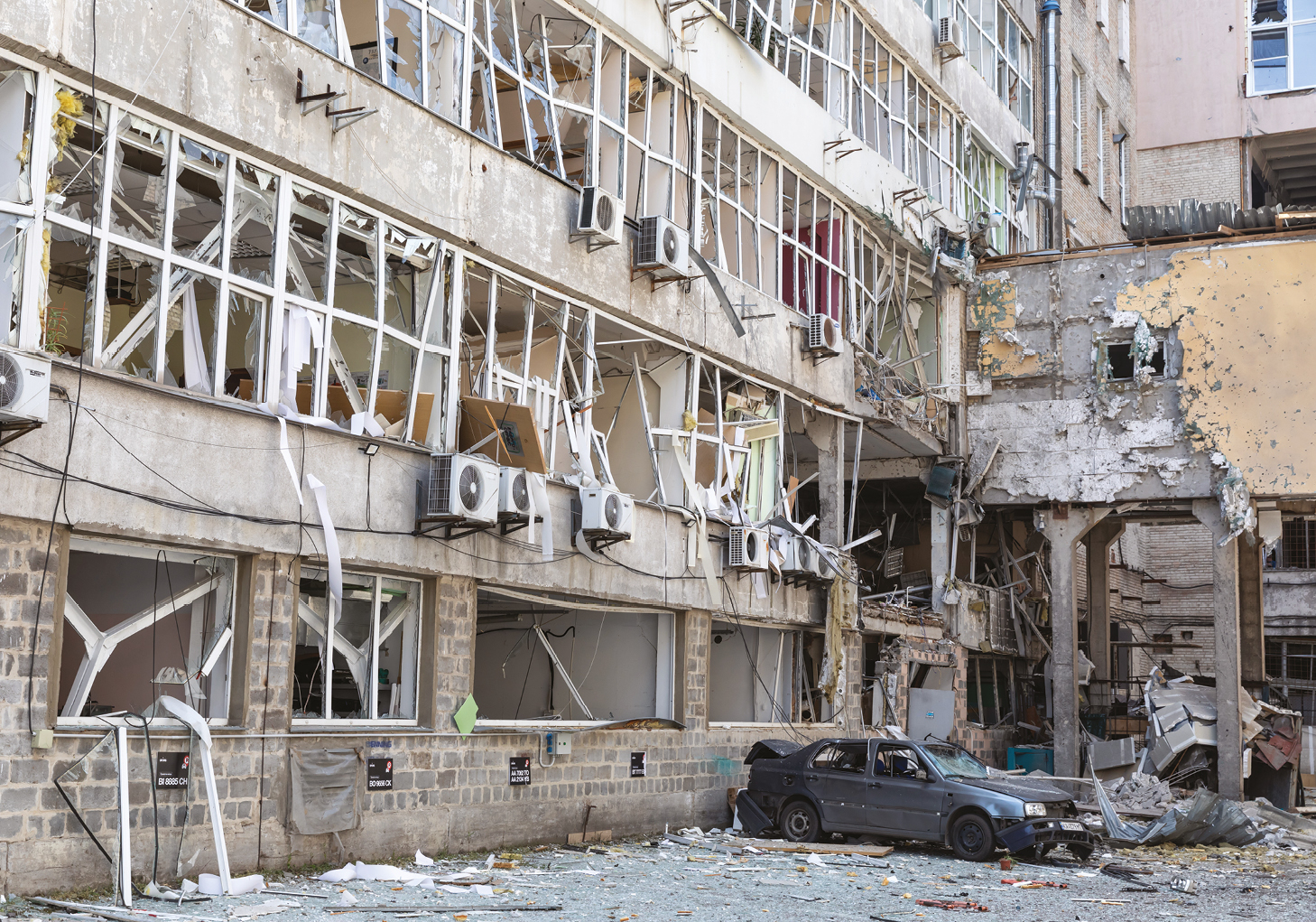
Even for those willing to invest, conditions on the ground remain profoundly difficult. Energy, transport and housing – the sectors hit hardest by Russian strikes and which together account for almost US$270bn of the US$588bn total needs – remain exposed to active wartime risk in many parts of the country.
There is also a geographic mismatch: new investment tends to cluster around Kyiv and the safer west of the country, according to a Citi Institute report, while the greatest reconstruction need lies in the war-torn east.
Raiffeisen Bank International (RBI), whose Ukrainian subsidiary is one of the country’s largest lenders, says sectors like renewable energy, agriculture and food processing “remain fundamentally attractive and economically viable”.
But “long-term reconstruction projects still require risk-sharing, guarantees or blended finance structures”, while demand for financing “exceeds available war-risk insurance and reinsurance capacity”, an RBI spokesperson says.
“Many commercially sound projects remain investable in principle but not fully financeable without additional risk mitigation tools.”
War-risk insurance emerges as a structured market
As far as those tools go, war-risk insurance is a key option. Three years ago, the market barely existed: in September 2023, the World Bank’s Multilateral Investment Guarantee Agency (Miga), which provides political risk guarantees against threats including war damage, expropriation and currency restriction, had a total Ukraine guarantee exposure of just US$185mn. Dragon Capital was then the only company to have secured cover through the agency.
Since then, the war-risk insurance sector has expanded rapidly, with governments, multilaterals and private insurers coming together to gradually build underwriting capacity. The scale of Miga’s support has also grown: the agency tells GTR it has now issued US$573mn in guarantees for Ukraine since February 2022, with a further US$32mn in the pipeline, bringing its total issued and prospective support to US$605mn across nine projects.
“Many commercially sound projects remain investable in principle but not fully financeable without additional risk mitigation tools.”
Raiffeisen Bank International spokesperson
Another example is the war-risk reinsurance facility launched by McGill and Partners, ARX and Lloyd’s of London for commercial property and other fixed assets, including infrastructure, new construction and renewable energy projects. Initially offering up to US$50mn of cover per policy, the programme has since doubled its capacity to US$100mn per risk and expanded from seven to 14 participating London-market insurers.
Meanwhile, the EBRD’s €110mn guarantee programme with Aon, designed to support more than €1bn of inland cargo and vehicle movements annually and encourage international reinsurers back into the Ukrainian market, reached full capacity within nine months. By that point, it had insured a cumulative €360mn of goods and vehicle movements. The development bank says it is working towards expanding the programme.
Some vehicles remain more promise than practice. The US-Ukraine Reconstruction Investment Fund, launched in April 2025 to invest in critical minerals and other strategic sectors, signed a political risk insurance framework with Miga in June. But Miga tells GTR that “no specific projects have been identified for coverage under the framework” to date.
The shortage of capacity is particularly acute in Ukraine’s local insurance market.
For insurers, such as ARX and Kniazha VIG, “demand exceeds supply, especially for corporate clients who are still fully uninsurable and unreinsurable”, says Nataliia Myronova, Kniazha VIG’s head of reinsurance. As recently as 18 months ago, war-risk cover available to corporate clients through local insurers was capped at around US$500,000, she says.
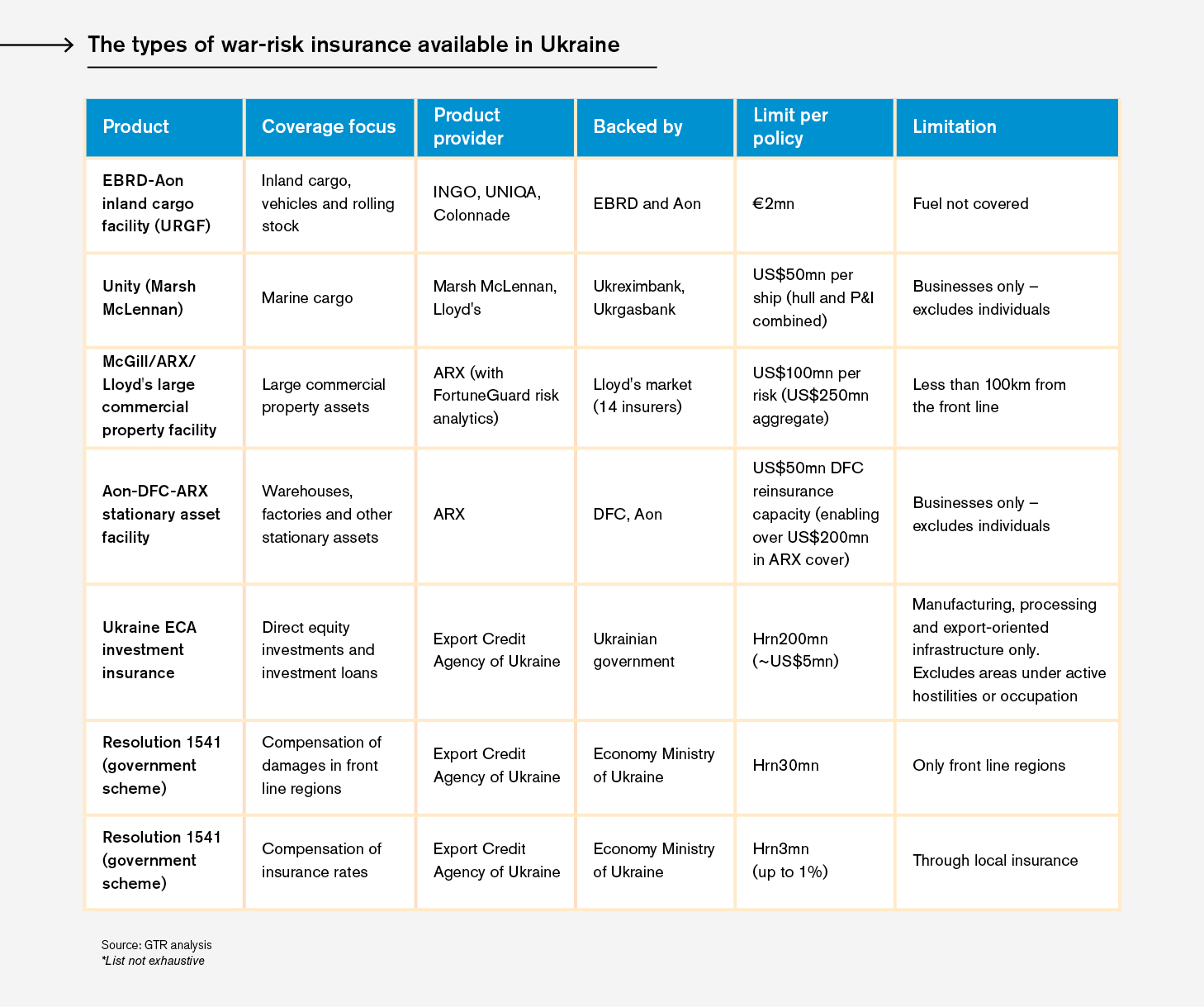
Several public institutions have stepped in to bridge part of that gap. Kniazha’s own SME facility, backed by the US International Development Finance Corporation, now provides up to US$2.5mn of war-risk cover per risk and is expected to be renewed on the same terms.
Ukraine’s export credit agency has also introduced two war-risk insurance products since November 2023, covering direct equity investments and investment loans, both for manufacturing and processing facilities as well as infrastructure supporting export-oriented Ukrainian production, and capped at Hrn200mn (US$5mn) each.
It also launched a separate compensation scheme in January this year, which reimburses businesses in nine designated high-risk regions for war damage already suffered and premiums already paid on war-risk policies, up to Hrn30mn (around US$670,000) per business.
Meanwhile, the EBRD’s Enterprise Security Enhancement pilot, launched in May 2026 with PrivatBank and Raiffeisen Bank Ukraine, lets partner banks write off part of a loan if the underlying asset is destroyed as a result of war, with the EBRD compensating the bank for the credit loss.
“The mechanism applies only to capex sub-loans financing fixed assets, not working capital,” the EBRD says. It describes the scheme as “an important innovation because it tackles a risk that insurance does not yet fully cover”.
The programme “preserves the incentive for businesses to invest in productive assets, even during wartime, by ensuring that a company is not left carrying the full debt burden of an asset destroyed by a missile or drone strike”.
“There is no reason for anybody to wait for anything for after the war. You have to do things now.”
Tomas Fiala, Dragon Capital
Despite the market’s growth, it is still far from mature, with pricing reflecting that scarcity. Quoted premiums on McGill’s ARX/Lloyd’s-backed facility – which uses AI and projectile data to insure assets more than 100km from the front line – start at around 2% of insured value per annum – with McGill confirming “most rates are currently minimum 3.5%” – then vary according to location, proximity to critical infrastructure and local strike history.
So while efforts to increase capacity have widened access to cover, pricing remains inextricably linked to the battlefield.
“We believe that only a ceasefire can reduce prices, but demand will decrease too,” Myronova at Kniazha VIG says.
ECA takeover
Before Russia’s invasion, private insurers wrote nearly a quarter of Ukraine’s political risk insurance, with multilaterals barely present, according to OECD analysis based on Berne Union data.
Since then, the picture has completely inverted: between 2022 and 2025, ECAs accounted for almost 78% of all political risk cover issued for Ukraine, multilaterals a further 21.8%, and private insurers less than 0.3%.
Poland’s Kuke was the first ECA to resume cover for Ukraine after the invasion, re-entering the market in June 2022. Four years on, deputy chief executive Katarzyna Kowalska says the agency assesses Ukrainian risk “not only in a standard way, as for all 201 markets we insure, but also better than the credit risk of many Western European countries”.
Kuke has recorded €2bn of short-term receivables insured since re-entry, against just €300,000 in losses, while its short-term portfolio grew 18% in 2025 alone. Its €1.5bn transport reinsurance programme launched in April has “sufficient capacity to support growing exports”, and interest in its investment insurance products has begun to “grow dynamically”, with its medium- and long-term portfolio now exceeding €500mn.
KPMG counts 14 national ECAs now offering political or violence risk cover for the country – and the role those agencies play has also evolved.
The Export and Investment Fund of Denmark (EIFO), for instance, no longer simply supports exports but also finances investment across sectors central to Ukraine’s reconstruction. Alongside a €381mn commitment for Ukraine’s largest wind farm, the agency has completed 31 other transactions worth roughly €170mn and accumulated a €916mn pipeline of 32 further projects.
“We discuss Ukraine during every meeting with other ECAs.”
Katarzyna Kowalska, Kuke
A separate €20mn export credit pilot with the European Investment Fund to guarantee Ukrainian SME transactions has struggled. “So far, the results have been limited,” the Danish agency tells GTR, with 24 months left before EIFO decides whether to expand the programme.
UK Export Finance too has been a major backer, providing £3.5bn of financing cover for Ukraine since the invasion. But the amount available for reconstruction is smaller than the headline figure suggests: a single 2025 guarantee backing a 19-year, £2.5bn Thales missile contract used up the bulk of it.
There is also cooperation between agencies. “We discuss Ukraine during every meeting with other ECAs,” Kuke’s Kowalska says, “most recently during the Ukraine Recovery Conference in Gdansk”. Kuke is working on a joint energy-sector transaction with two other ECAs, she adds.
“The agencies do not compete by snatching deals from one another.”
Deploying capital comes with challenges
Despite the costs and gaps the market faces, capital is increasingly finding its way into Ukraine through fund closes, development bank lending, blended structures and domestic guarantees alike.
Dragon Capital, for instance, completed the first close of its Amber Dragon Ukraine Infrastructure Fund I in May, raising €207mn for investment in power generation, rail and digital networks in efforts to rebuild infrastructure systematically targeted by Russian strikes. Meanwhile, its €1bn-targeted European Flagship Fund has drawn roughly €260mn so far.
Four years on from the start of the invasion, the EBRD – the “first IFI that made the decision to support Ukraine”, according to Lesya Kuzmenko, the bank’s deputy head of Ukraine, industry, commerce and agribusiness – has deployed over €10.8bn in Ukraine, channelling €550mn into the country under its Trade Facilitation Programme in 2025 alone.
Blended structures are also proving workable at project level. When a Lviv manufacturer needed financing for trolleybuses bound for Ivano-Frankivsk and Ternopil, state-owned Ukrgasbank split the deal into two tranches: one through the EBRD and Raiffeisen for Czech-made Škoda motors; the other covered Polish-made batteries, insured by Poland’s Kuke with backing from development bank BGK. The transaction, Ukrgasbank’s first such deal in over a year, won a GTR Best Deal Award in 2023/24.
But for Ukrainian banks, the question is often less whether capital exists than whether it can be deployed quickly and affordably.
Sergii Kochuk, acting director of the trade finance department at Ukrgasbank – now the country’s largest trade finance bank with a portfolio of Hrn17.1bn (roughly US$390mn) – says demand for financing under its €230mn EBRD-backed portfolio risk-sharing facility for decentralised energy projects is “exceptionally high and concentrated in geographic regions hardest hit by grid instability and energy-intensive industries”.
The core gap, he adds, “comes down to two factors: pricing and transaction speed”. An ECA guarantee “can certainly serve as an alternative collateral, [but] ultimately, everything depends on the price”.
Beyond the war itself and the scarcity and cost of capital, investors face significant governance and operational challenges. For one, the country is embroiled in a major corruption scandal: its National Anti-Corruption Bureau uncovered an alleged US$100mn kickback scheme at state nuclear operator Energoatom in November 2025. The investigation implicated a former business partner of President Zelenskyy and prompted several high-level resignations.
A separate raid in August linked to an alleged money-laundering operation was followed by the dismissal of a senior presidential aide. The country’s judiciary, despite recent reforms, has yet to fully convince investors that contracts and disputes will be resolved swiftly and impartially.
“The number one impediment, besides the security risks, is courts,” Dragon Capital’s Fiala told the Riga audience.
He pointed to reforms including a new Supreme Court and the consolidation of anti-corruption functions within the Economic Security Bureau, but said Ukraine’s institutional architecture remains at an early stage. The bureau itself was caught in an internal corruption scandal in June, when two officials were accused of taking bribes.
Ukraine also faces a lack of skilled workers, with millions of Ukrainians still displaced.
Keeping goods moving
- The Ukrainian Maritime Corridor, a Black Sea shipping lane opened under naval protection in August 2023, carried roughly 208 million tonnes of cargo before most ships ceased using it at the end of July amid escalating Russian attacks.
- EU Solidarity Lanes – the bloc’s overland and river routes built to bypass Russian-blocked Black Sea ports – have moved over 220 million tonnes of Ukrainian goods since May 2022, carrying around 80% of non-agricultural exports and 70% of imports as of June 2026, a figure likely higher since the maritime corridor shutdown.
- Ukraine is currently routing what it can via rail links with Eastern Europe (around 45%) and the Danube (around 45%), with the remaining 10% by road.
Hope for change
Despite growing support across the global trade finance industry, the scale of the challenge remains sobering. Yet the mood among many of those already operating in Ukraine is strikingly more optimistic than the headlines would suggest.
“I see more interest in Ukraine today than at any other point in my time leading Citi’s operations there,” wrote the bank’s country officer for Ukraine, Alex McWhorter, in its Rebuilding Ukraine report. “We’re having conversations all around the world […] around Ukraine’s recovery.”
Indeed, the country is already brimming with stories – like Kormotech’s – that show recovery is not some distant concept but a reality taking shape on the ground.
“Ukraine is not waiting for peace to start rebuilding,” said European Commissioner for Enlargement Marta Kos in Gdansk. “It is repairing roads, restoring water systems, building homes and keeping businesses alive while the war continues.”
For the EBRD’s Kuzmenko, this perseverance in the face of difficulties captures the very essence of life in war-torn Ukraine: “Sometimes we have very difficult nights with a lot of shelling around Kyiv.
“Despite that, we all wake up in the morning and go to our business meetings, conferences, our offices, as if nothing has happened. Resilience is our business survival mode.”