


Countries across East Africa are looking to diversify their trade amid the ongoing impact of the Middle East conflict.
Several import-dependent nations across the region, including Kenya, Ethiopia, Uganda and Zambia, are being pinched by the closure of the Strait of Hormuz. The Gulf is a major transshipment point for essential imports, including oil and fertilisers, into Africa’s east coast.
As a result, “new trade routes are being created and new trade partners are being sought”, said Allen Asiimwe, deputy CEO at aid-for-trade organisation TradeMark Africa.
East Africa is “discovering trade corridors we didn’t have 18 to 24 months ago”, added Phanice Mokua, head of trade at Stanbic Bank Kenya, while speaking on stage at GTR East Africa in Nairobi last week.
The region is looking to ramp up trade with Asian economies such as China, which last year announced duty and quota-free access for 53 exporting countries in Africa, as well as strengthen commerce with established partners across Europe, Asiimwe said.
She added there was “a lot of renewed interest in resource minerals – we must look at where the demand is and where we can trade”.
The TradeMark Africa chief said the development group, which promotes economic growth in Africa by working closely with regional intergovernmental organisations and the private sector to reduce trade barriers, was also focusing efforts on “shifting some of the regional value chains internally”.
“There’s a lot we can take advantage of in the intra-African trade aspect – the regional value chains for fish and horticulture, these are huge, not just from a livelihoods aspect, but from a real potential for industrialisation and growth for the continent.”
Data from the African Export-Import Bank shows total intra-African trade reached US$220bn in 2024 and is projected to hit US$230bn in 2026, while intra-East Africa trade alone hit US$7.2bn in 2024 after a decade of 11.4% annual growth, driven largely by gold, rice and cement exports.
Gabrielle Reid, head of advisory at consultancy Pangea-Risk, said the current Gulf crisis is acting as a “catalyst for change” accelerating efforts to strengthen intra-Africa trade and regional supply chains.
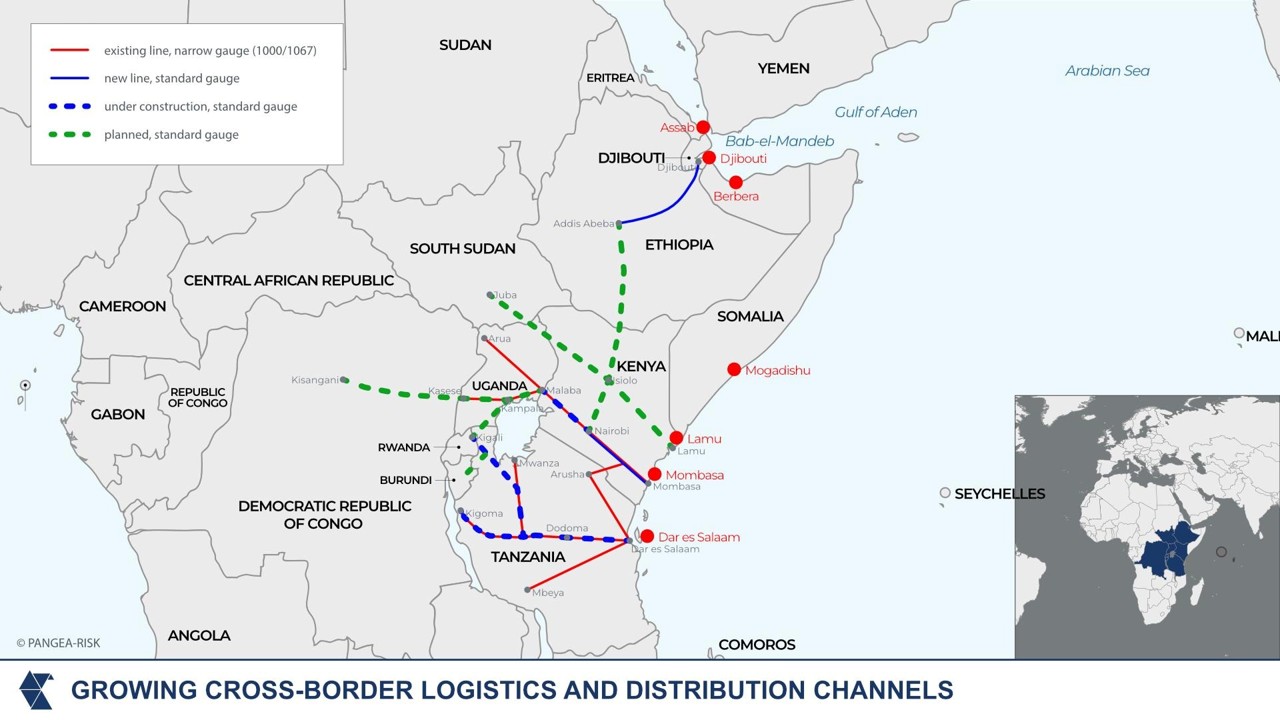
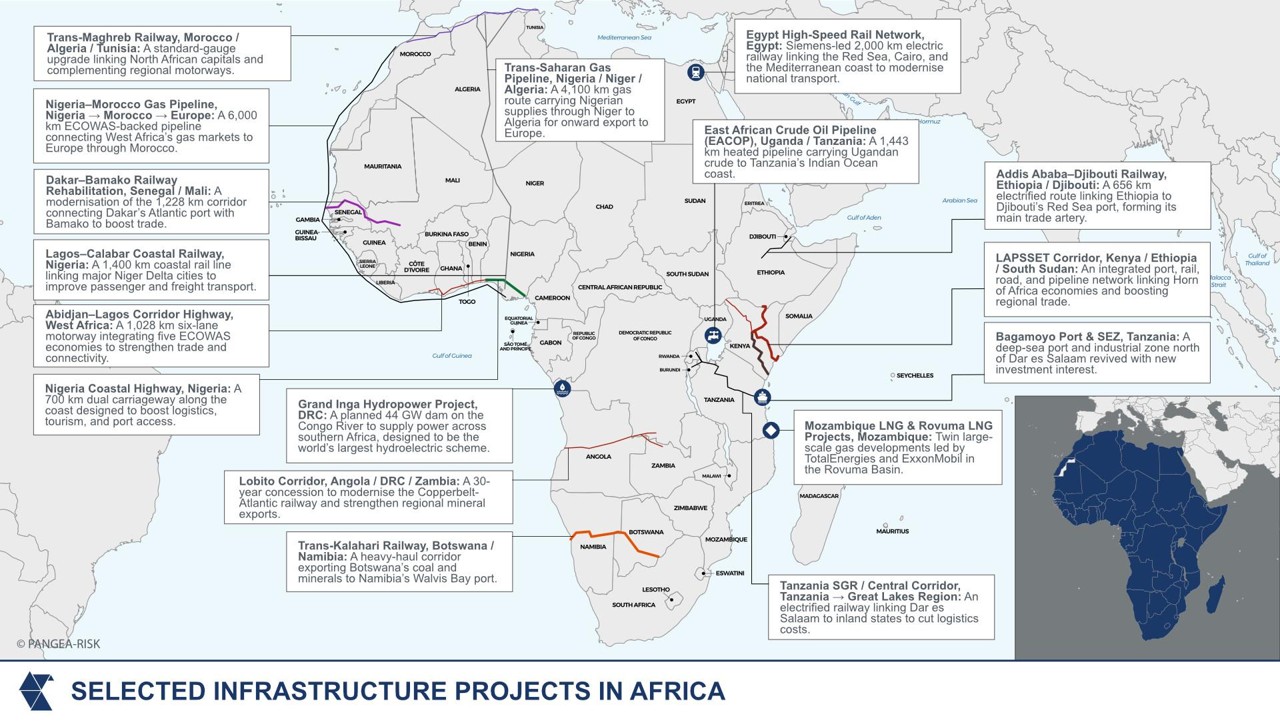
“We’re already seeing expanding logistics corridors,” Reid said, pointing to the Northern Corridor and the Central Corridors – two critical multimodal trade routes in East and Central Africa designed to connect landlocked countries to the sea ports of Mombasa in Kenya and Dar es Salaam in Tanzania, respectively.
These two routes are “likely to form the backbone of unlocking regional trade opportunities, particularly for East Africa”, she said.
Reid added nations were increasingly looking at digital and cross-border payments and that there was “a real urgency for African countries to take their energy security seriously”.
The image illustrates a map of Africa with various cities and countries, highlighting existing and planned standard gauge rail lines and their intended roles in enhancing cross-border logistics and distribution channels.
Many African nations have begun investing in major energy and trade infrastructure projects to avoid dependence on imports from the Gulf countries and vulnerability to shocks.
The long-awaited Dangote refinery in Nigeria, which was under construction for nine years, is finally operating at high capacity as of this month, allowing the country to supply markets across the continent amid the current global squeeze. A second refinery planned by Dangote in Kenya, if brought to fruition, could also help reduce East Africa’s reliance on Gulf exports.
Meanwhile, Angola’s Cabinda refinery has ramped up production and exports in light of the Middle East conflict.
A state-backed refinery project in Uganda’s Hoima region is also in the works. The government signed the implementation agreement for the US$4bn project in partnership with UAE-based investor Alpha MBM Investments, a member of the Dubai royal family, in March 2025, but construction is not expected to start until later in 2026 at the earliest.
Reid added that “the success of the Dangote refinery and the latest discussions around refinery plans for Kenya and other operations on the continent to build Africa’s energy resilience” was “certainly an indication of intra-Africa trade and intra-Africa industrialisation starting to gain momentum”.
Last week, French shipping and logistics company CMA CGM announced a US$820m investment to modernise and expand two terminals at the Port of Mombasa in Kenya to bolster cargo-handling capacity and strengthen regional trade corridors.
According to projections from the UN Economic Commission for Africa, full implementation of the African Continental Free Trade Area agreement could boost intra-African exports by 45% by 2045 – an additional US$275.7bn – with the biggest gains in industry (48%) and agrifood (60%).
“We’re seeing a number of initiatives come to fruition at the same time. I’m seeing these as positive signals that we will move beyond energy as a case study,” Reid said. “We are in a short-term pinch because of the crisis, but the work is being done for East Africa to benefit in the medium and long term from the opportunities at play.”
The image depicts a network of proposed infrastructure projects in Africa, including railways, pipelines, and highways connecting various countries and regions for transporting oil, gas, and other goods.
Farida Abbas, CEO of the British Chamber of Commerce in Kenya, agreed the current trade disruption provided “an opportunity for the region” to look beyond the short-term and focus on the long-term investment landscape.
“We don’t have to sit back and wait for the future shock. We need to predict and say, what is happening in the next five, 10, 20 years?
“We need to make the environment more predictable and more conducive for investors to come in and set up factories. Whether it is alternative fuel or alternative resources, the cost of doing business needs to be improved.”