
Banks’ growing appetite for bespoke artificial intelligence tools is reviving a familiar debate about whether the technology will help connect the disjointed trade finance ecosystem or simply create another generation of digital islands.
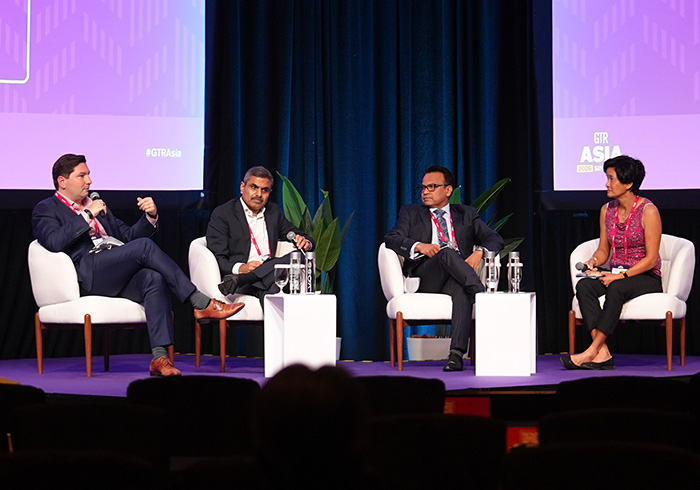
Industry figures speaking at GTR Asia in Singapore last week said AI tools will increasingly be tailored to reflect individual banks’ data, policies, credit appetites and workflows. At the same time, the technology is making it faster and easier to build applications aimed at ever-narrower parts of the trade finance process.
But speakers questioned whether this proliferation will further unite – or splinter – the digital trade landscape.
Patrick DeVilbiss, head of product for CGI’s Trade360 platform, said the digital trade ecosystem is likely to become more fragmented as AI adoption gathers pace.
“We will always have [fragmentation], and actually I would argue it’s only going to get worse, particularly with AI, where you can build applications much more quickly, and there’s going to be incentives to say, ‘Hey, now I can solve this even smaller piece of the global trade digitisation process’,” he said.
The digital trade space is already littered with platforms developed to solve specific problems or serve particular markets. Many have struggled to achieve scale or communicate with rival systems, despite years of industry work on common standards and interoperability.
DeVilbiss said the industry should stop viewing the elimination of fragmentation as a realistic goal and instead consider a “federated model”, where a patchwork of systems could still exchange data and support transactions using common standards and workflows.
“We’re never going to completely get to a nirvana,” he said. “But I think we can carve a course that says, in this fragmented world, if we can define standards and workflows associated with those standards, we can allow for more ability to pass data back and forth and transact much more seamlessly.”
No one-size-fits-all approach
Banks and technology companies are racing to develop specialised AI tools for trade finance. Recent launches include Aurionpro’s AI-native Fintra platform, which uses six agents to carry out tasks including document examination, sanctions screening, clause recommendation and risk scoring.
Digital platform Mitigram has also launched an AI agent that converts banks’ risk-pricing emails into structured data, initially focusing on export letter of credit confirmation and discounting requests.
Other speakers at the event said the need to tailor AI systems to individual banks could make a single, harmonised trade ecosystem more difficult to achieve.
Amit Maroo, senior vice-president and global product head at Intellect Design Arena, said AI tools cannot simply be lifted from one institution and dropped into another without accounting for differences in their operating models.
“AI has to go deep, understand what the policies of the bank are, what sorts of credit appetite they have, what kind of workflow they can follow for different exceptions,” Maroo said.
But GTR Asia speaker Angelia Toh, head of Asia Pacific trade finance at BNY, pushed back against the suggestion that AI will further fragment digital trade, arguing that its current applications are primarily focused on improving processes within individual institutions.
“I actually don’t think so,” Toh said when asked whether banks’ use of bespoke AI systems could create a more fragmented trade ecosystem.
“For now, I feel AI is really more inwards within our organisation. So if everyone is efficient, then I think that can lead towards [solving] all the more difficult questions on the digital ecosystem altogether.”
At BNY, that inward focus is already producing tangible results. Toh explained that BNY is using an AI agent to pick out trade loan requests among the tens of thousands of MT799 messages the bank receives each year, extract the relevant information and feed it into its processing system.
The bank has processed more than 20,000 transactions using the agent since beginning a pilot around 18 months ago, cutting processing time by 50%, she said.
“Chasing the wrong objective”
Rather than trying to eliminate fragmentation, speakers said the industry should focus on making separate systems communicate with one another.
Anand Ramachandran, vice-president of the global banking and insurance solutions practice at Oracle Financial Services, said attempting to eradicate fragmentation may mean “chasing the wrong objective”.
“The goal should be interoperability and not really avoiding fragmentation,” he said.
Samuel Mathew, managing director and global head of documentary trade at Standard Chartered, said separate digital islands would remain, but added: “We have to get the islands to start talking to each other.”
The International Chamber of Commerce’s Digital Standards Initiative (DSI) is working with developing country governments to support legal harmonisation and reduce the risk of individual markets adopting isolated systems or regulatory approaches.
At GTR Asia, the DSI’s managing director, Pamela Mar, said legal reform alone would not deliver the industry’s long-held vision of a harmonised digital trade ecosystem.
“Unless we solve interoperability, the legal reform is actually not going to have its intended effect,” she said, adding that this would be a major theme of the DSI’s work going forward.