
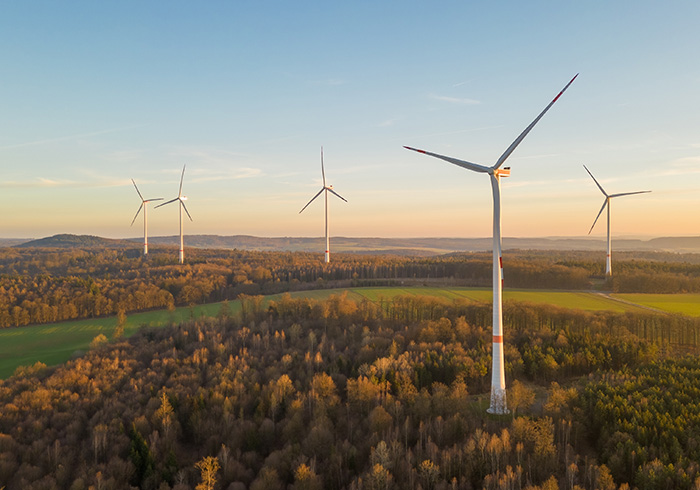
Crédit Agricole CIB has inked a strategic agreement with the European Investment Bank (EIB) that will see the lender build a portfolio of guarantees for wind energy totalling up to €1bn.
The EIB will provide a counter-guarantee of €500mn to Crédit Agricole, enabling the French bank to develop guarantees on behalf of its clients.
The organisations said the deal showed “their strong mutual commitment to encouraging the transition to green energy”.
The counter-guarantee will offer “a growth mechanism for wind industry players ranging from the supply chain to the electricity grid” to help mobilise private capital from other institutional and banking partners and support the development of the European wind sector.
Crédit Agricole said the wind-related investments in the economy the EIB guarantee is expected to support could total €8bn.
The EIB’s commitment is backed by InvestEU, a programme aimed at triggering €372bn in investments by 2027. The scheme was originally set up to boost the bloc’s economy in the wake of the Covid 19 pandemic.
Yves-Marie Gayet, global head of international trade and transaction banking at Crédit Agricole, said: “The energy transition requires major investments and solid co-operation between public and private actors.
“By supporting the development of wind energy and its infrastructure, we are helping to strengthen the entire supply chain. Thanks to innovative financial solutions and our partnership with the EIB, we support our clients in their strategic projects and contribute to Europe’s sustainable energy security.”
Jean-François Balaÿ, Crédit Agricole’s chief executive, said the agreement marked a “strategic milestone” for the bank.
“This collaboration strengthens our capacity to support structural projects in the wind energy sector and to generate concrete impact in favour of the development of sustainable infrastructure,” Balaÿ added.
Emmanuelle Trochu, global head of official institutions coverage at the lender, said the agreement shows “the importance of participating in the development of wind energy in order to increase Europe’s energy independence by boosting decarbonised energy production”.
Last month, the EIB revealed plans to expand its role in trade and export finance, in a bid to boost trade with high-risk countries and help Europe compete with China.
This involves an ambition to launch a “global trade finance platform” and explore the use of “political risk insurance instruments”.
Last year, Gayet told GTR that the bank was shifting its focus towards renewable energy and positioning itself “to lead large infrastructure and transition energy projects requiring large volumes of guarantees”.