

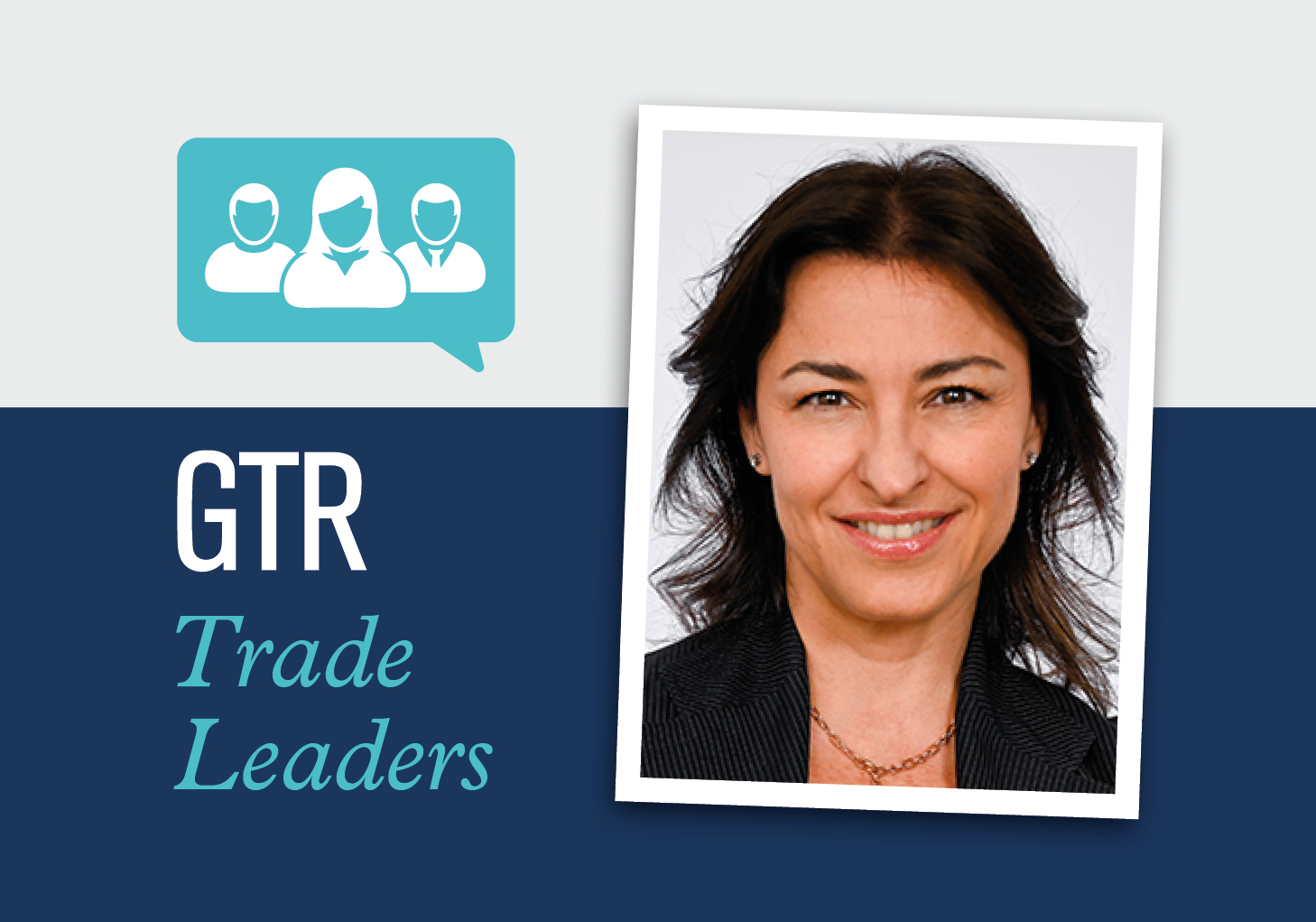
When Michela Cicenia took over as global co-head of global trade at Natixis CIB two years ago, her priority was clear: break down internal silos and build a business organised around clients rather than products. As new opportunities emerge in areas such as data centres, defence and the energy transition, she explains how that strategy is reshaping the bank’s trade finance business.
In this latest instalment of GTR‘s Trade Leaders series, Cicenia discusses growth, digitalisation and leadership, and reflects on developing the next generation of talent, building inclusive teams and the personal experiences that have shaped her career.
GTR: It’s now been two years since you became global co-head of global trade. When you stepped into the role, what was your ambition for the business?
Cicenia: When Guillaume [Genet] and I were appointed to lead the business together, the first question I asked myself was how we could really leverage our different and complementary experience. We knew there was a reason Natixis CIB had brought us together, and the ambition was that the way we worked would become an example for the rest of the team.
For me, the reorganisation was first of all a leadership decision, a responsibility – accepting that the way we were structured no longer matched the way the world and our clients operate. I’ve had the chance to work in different environments and roles across trade and structured finance, and I learned that the most innovative and robust solutions often come from people who don’t usually sit together. This gave me both the conviction and the confidence to push for a more integrated, cross‑silo model.
Natixis CIB has a very strong and long-standing commodity trade finance franchise. When I joined four years ago, my mandate was to develop the corporate trade finance business and connect all its strengths. We already had great products and solutions, but probably not yet the client base we needed to really expand.
So we reorganised the team around expertise – sector expertise, product expertise and solution expertise. The idea was to blend experience and build on what Natixis CIB was already recognised for. We’ve always been very strong in sectors like energy, metals and mining and agri, but those sectors don’t represent 100% of the opportunities in trade finance.
For me, the bigger shift was that we stopped looking at sectors in isolation and started looking at ecosystems. That was really the new mindset we wanted to bring. It means understanding the whole value chain, not just because a company belongs to a particular sector, but because it’s influenced by everything happening around it.
A good example is energy. We renamed our oil and gas sector to energy transition and mobility because we wanted to reflect where the market was going. At the time, the EV battery value chain was becoming extremely important. Today we see the interdependence between different sectors much more clearly – even between telecoms, technology and energy. One depends on the other to grow, and that’s really what this ecosystem approach is about.
The beauty of being smaller is that we can work across platforms, across sectors and across regions much more easily. It’s not always easy – it takes work, especially from managers – but I think that becomes one of our biggest strengths.
GTR: Where are you seeing the biggest opportunities for growth today?
Cicenia: Data centres are probably the clearest example. We already had deep expertise in the energy sector, and we were able to adapt that to a completely different type of client.
In the US, we’re particularly focused on electrification and power, with a developed portfolio of financings at the junction of digital and energy – particularly around the connection between electrical grids and data centres. Aerospace and defence is another sector where we’ve invested because it’s changing dramatically. Companies are thinking differently about procurement, critical suppliers and geopolitical risk. The risks are not the same as they were before, the volumes needed are not the same, and those companies have to build much stronger supply chains. That’s where our expertise can really bring something.
We’re seeing something similar in engineering and construction. Those companies are moving from traditional fossil fuel projects towards hydrogen, renewable energy and other new technologies. The products we offer may be familiar, but the dialogue with clients is different because you need to understand the technology behind the project if you want to structure the right solution.
GTR: How has the business performed over the past two years, particularly given lower commodity prices and geopolitical uncertainty?
Cicenia: On the commodities side, the business is naturally linked to commodity prices. We’ve seen prices come down over the last couple of years, so that has had some impacts on activity.
But at the same time we’ve been growing our corporate trade finance business, so overall we’ve continued to grow. In areas where we’ve made targeted investments, particularly working capital, we’re already seeing double-digit growth, which is very encouraging.
We want to keep that pace while remaining selective. We know the sectors where we have a real competitive advantage and the trade corridors where we can really differentiate ourselves. The recent reorganisation of Asia and the Middle East will help us continue growing in those strategic corridors while broadening our presence beyond oil and gas
In the Middle East, we’re transforming our 20-year franchise historically focused on project finance and oil and gas into a diversified offering.
Geopolitics has changed supply chains, but because we’re very close to the major commodity traders, we were able to follow those changes very quickly. We didn’t necessarily see the impact immediately, but over time we’ve seen how fast they adapted, and we were able to adapt ourselves as well.
So, of course, there have been challenges, but we’ve also seen a lot of opportunities, whether that’s export finance, structured finance or the investments that will be needed in the next phase of the energy transition and reconstruction.
GTR: Tell us about the investments you’ve been making in working capital and digital capabilities. What’s driving that?
Cicenia: As the business grows, you can’t continue to work manually.
One of our biggest investments has been in our back-end platform. We’re building the same platform across all our locations so clients have a consistent experience, whether they’re using receivables, payables or syndicated structures. If we want to scale the business, we need that operational capacity.
On the client side, we deliberately chose not to build a single-bank platform. Instead, we’ve invested in connecting to multiple bank platforms because we strongly believe that’s what clients want. We’d rather adapt to their needs than ask them to adapt to ours.
In some ways we’re fortunate because we’re investing at a time when the market is changing very quickly. Working capital is a business that needs automation, but it’s not only working capital. We’re investing across the board.
We’re a shareholder in Komgo and continue to contribute to its development. We’ve also built our own Trade Tracker, which gives clients real-time visibility over where their trade finance transactions are. Knowing exactly where a letter of credit or guarantee is in its lifecycle is very valuable because it helps clients manage their cash flow.
Artificial intelligence is being deployed step by step to help our teams with complex daily tasks. We have placed an emphasis on change management and training, since we believe it’s a cultural shift before anything else.
The beauty for us is that we can choose where to invest based on what clients need today, rather than being constrained by technology decisions we made years ago.
My forthcoming appointment as a Swift council member, leveraging my expertise in trade and cash, highlights our commitment to bridging these domains.
GTR: Throughout our conversation you’ve come back to people and leadership. What kind of leader do you aspire to be?
Cicenia: Nothing I’ve described would have been possible without people. Guillaume and I have always been very aligned on that.
I’ve invested a lot in developing soft skills throughout my career, and it’s the message I always try to pass on to younger colleagues. Today, technical competence can be acquired at any time, and with artificial intelligence that will become even more true. What really matters is your ability to accompany people on their journey, to keep them motivated and to understand what drives them – what puts them in motion and emotion.
I’m convinced people perform at their best when they’re happy. That’s why I spend a lot of time listening and trying to put myself in other people’s shoes. When you understand the person behind the role, you understand how they can contribute in the best possible way.
I also lead Natixis’ female network WINN Natixis Association, but for me diversity is much broader than gender. It’s about accepting different backgrounds, different stories, different experiences and different expertise. We shouldn’t be afraid of changing the rules if we understand the people behind them.
Behind every business, behind every transaction, there is a human angle that needs to be cared for. If we lose sight of that, it’s very difficult for any project to succeed.
That’s also why we’ve invested in developing our future leaders. We have a leadership circle, we have a Generation Z programme, and we spend a lot of time listening to younger colleagues. The decisions we make today will shape the organisation they inherit tomorrow, so if we don’t understand what matters to them, it will be very difficult to keep growing.
GTR: Finally, what gives you energy outside work?
Cicenia: I’m a very transparent person. What people see is what they get. I always say what I think, and I think what I say. So I don’t have any problem talking about my life outside work.
My biggest passion is my family. I love travelling with my two children and spending time together. I also have a daughter with health challenges, and we’ve really grown together through that journey.
I often say that I get energy from my family to do what I do at work, and I get energy from my work to do what I do for my family. For me, that’s absolutely true.
There were moments when I wondered whether I should change jobs or step away from my career, but every decision I made was thanks to my daughter. We are on that journey together, and I realised that, for her, having a happy mum was much more important.
I also make time for myself. I love ballet, I go to the gym and I practise yoga. When you have a demanding career and a family, you have to take care of yourself as well. You have to learn how to manage your emotions and your stress. For me, that’s really what soft skills are about. They’re not just communication skills. The more you know yourself, the better you manage that.