

Hot on the heels of a 2023 refresh, a new round of talks kicked off this year to hammer out another modernisation of the OECD Arrangement on Export Credits. Exporters and banks are now jostling to draw attention to the changes they want made to the rules that govern export finance in wealthy nations. What is on the table this time around?
The 137 pages of the OECD Arrangement on Officially Supported Export Credits constitute a sacred text for the export finance ecosystem in high-income countries.
The rules, first agreed in 1978, govern how export credit agencies (ECAs) in participating countries offer cross-border financing, guarantees and insurance. Making changes to its highly technical stipulations on what can be financed, how long it can take to be paid back and what premiums may be charged – as well as thousands of words of related minutiae – is typically a years-long and politically charged negotiation process.
In 2023, the 11 participants of the Arrangement clinched a deal to modernise the text, the first such package of measures since the early 2010s.
But just three years on, participants – including some of the world’s biggest powers – have decided they’d like to have another go. ECA heads have dubbed the efforts Modernisation II.
G7 finance ministers and central bank governors said after a summit in May that reform of the Arrangement “is essential to enhance the competitiveness of our exporters against the mounting competitive pressure of non-OECD countries, and to maintain a level playing field among exporters”. Describing the fresh round of talks over the future of the accord, the policymakers said they “reiterate the importance” of keeping the Arrangement fit for purpose and called for “the swift completion of its modernisation”.
The call underscored the urgency and importance attached to the work of ECAs at a time when the OECD members are trying to maintain their positions in global supply chains.
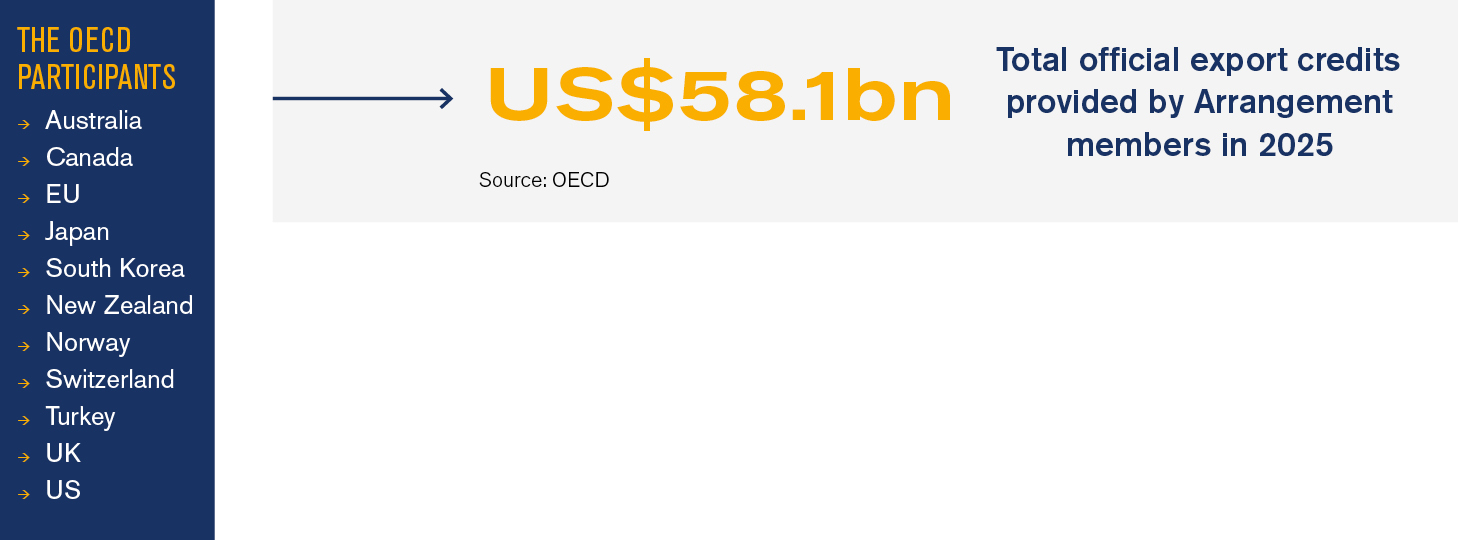
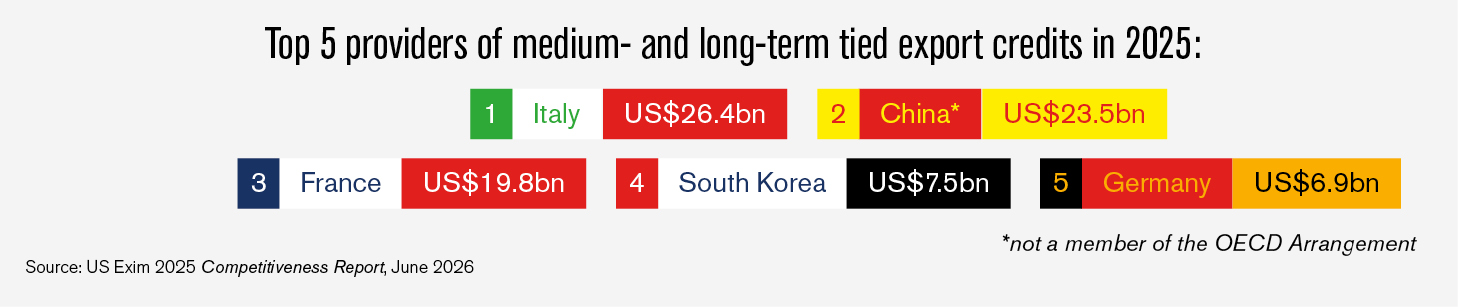
The effects of reforms to the Arrangement extend well beyond how competitive OECD exports can be. Tweaks can translate into fluctuations in the costs of infrastructure projects such as power plants, highways, airports and water systems, especially in developing countries. It also has consequences for the ECAs and the commercial banks that fund export finance facilities: Arrangement participants provided US$58.1bn in official export credits in 2025, according to the OECD.
ECAs and their governments are tight-lipped about what items are even on the agenda for the latest round of talks, which centre on three in-person meetings held by participants each year. But these are the areas where there is pressure for change and the possibility of an outcome.
Critical minerals
Although talks over major changes to the Arrangement can sometimes be fractious, there is at least one area where there appears to be a broad appetite for reform this time around: critical minerals.
They have been at the centre of many big ECA deals in recent years, being crucial inputs to a range of rapidly growing sectors, such as batteries, electric vehicles and AI infrastructure. Now there is a push to carve out favourable treatment for such financing in the Arrangement.
Major OECD economies appear in a hurry as they try to eat into China’s dominance of critical mineral and rare earth processing – critical minerals were the only area singled out in the G7’s May statement urging reforms to the Arrangement. It is also a major focus for the Export-Import Bank of the United States (US Exim), one of the most influential participants. Alongside the US, ECAs in Australia, South Korea and the UK have been among those ploughing investments into critical minerals mining and processing projects.
Potential changes to the Arrangement to make it easier to secure financing for critical minerals deals include extending the maximum tenor of loans to beyond 20 years, introducing flexibility in repayment terms and potentially allowing for lower premiums, says Yoshi Ichikawa, head of development and agency finance, Europe, at Standard Chartered.
Such measures would mirror the “sector understandings” for specific industries that already provide tailored terms under the Arrangement. Critical minerals could ultimately be the centrepiece of this package of reforms, Ichikawa says, just as the introduction of a swathe of favourable treatments for climate-friendly projects underpinned the last modernisation.
Turning 85/15 to 95/5
One of the most debated elements of the Arrangement in recent years has been what is known as the down payment rule, also referred to simply as “85/15”. This part of the accord dictates that a maximum of 85% of a contract value can be financed with ECA cover, with the remaining 15% financed separately. This residual amount is often financed by lenders on commercial terms.
During the Covid-19 pandemic, the OECD trimmed the down payment to just 5%. This temporary measure was then extended, before expiring at the end of 2024. The move delighted big banks that arrange deals because it boosted the size of the ECA-covered financing they could offer. But local lenders in regions such as Africa, which had developed a line of business financing down payments, were dismayed.
The debate is set to be reignited. Business at OECD (BIAC), a group representing the main industrial lobbies and commercial chambers of member countries, has called for the down payment to be reduced again to 5%, permanently. It argues deals have been scuppered because private lenders have been unwilling to shoulder the 15% risk without cover in riskier countries.
For businesses, BIAC says in a position paper, “this adjustment would enhance competitiveness in high-risk markets, as companies would be able to offer more attractive financing terms without increasing their own commercial exposure”.
“It would also ensure that the projects remain viable and can proceed despite cash constraints on the part of the borrower, thereby supporting long-term trade relationships and contributing to development outcomes.”
“Everything could be on the table; everything could be not on the table.”
Yoshi Ichikawa, Standard Chartered
The European Banking Federation (EBF) – the peak lobby group for the continent’s banks – says the 15% down payment could be maintained, while giving ECAs the flexibility to cover up to 95% of a contract’s value if they wished.
“This would immediately strengthen the competitiveness of OECD-supported financing compared with international competitors operating under fewer constraints, while having a limited impact on financiers and ECAs,” the EBF says in its own position paper. It argues such a change should apply to countries classified as medium to high risk, where deals are more difficult to get over the line.
Standard Chartered’s Ichikawa says the brief period in which the down payment was cut to 5% was “enormously helpful” to bring deals together.
The idea doesn’t have universal support. Local lenders that have traditionally picked up this piece of an export finance deal may lose out. Chris Mitman, managing partner at Acre Impact Capital, a fund that specialises in financing down payments, is also opposed.
He says export finance is already up to a third cheaper than alternatives such as a sovereign bond.
Acre analysed the impacts of the 2023 modernisation and found they boosted affordability of export finance during the first 10 years of repayment by 25%. But returning to a 5% down payment, he says, would only provide an extra 1% benefit.
“The central premise upon which I’m hearing we have to do this, for affordability, isn’t supported by the data,” he tells GTR.
He says there is a “growing ecosystem” of funds like Acre, development finance institutions, regional banks and commercial insurers who can finance the 15%. A new sector understanding for social projects – which was discussed during the last modernisation process and would extend tenors to 22 years for eligible deals – would have a much bigger impact on affordability.
Paolo Pinna, a shipping and export finance partner at law firm HFW, says ECAs may worry that shrinking banks’ uncovered exposure to such a degree could inadvertently undermine underwriting standards.
“The fact the lender is almost 100% insured by an ECA” could prompt banks to carry out less rigorous due diligence than they would have if they had a larger direct exposure, Pinna suggests. He says such a move risks creating “a sort of economy which is only based on ECAs, because the risk is taken almost totally by ECAs rather than the bank”.
Local costs
While the raison d’être of ECAs is stimulating exports from their home markets, the Arrangement also allows agencies to cover some local costs of an underlying project. These are elements like employing a local plumbing contractor for a hospital, or cement suppliers for a high-speed rail project. But there is widespread support among exporters and financiers for doing away with the restrictions on how those local costs can be covered.
Currently, an ECA-backed contract can include financing for exports from the ECA’s country, as well as inputs from third countries. But support for costs incurred in the buyer’s country is subject to separate limits under the Arrangement, with a maximum of 50% covered by ECAs.
Standard Chartered’s Ichikawa argues this creates a situation where competitively priced goods or services readily available in-country are disadvantaged in favour of imports from overseas. “This is making everybody unhappy,” he says.
“From a borrower point of view, it doesn’t make sense. From a contractor, exporter, EPC contractor point of view, it doesn’t make sense,” he says. “ECAs must be indifferent between the third country and local costs so long as their own national content is satisfied.”
Pointing to a market like Turkey, where high-quality construction materials and services are plentiful, he argues that being able to more easily use that content would make the project more competitive and more profitable overall.
The EBF has called for all local costs to be included in ECA coverage. It argues the reform would stop civil works and other activities “being shifted to neighbouring countries solely to satisfy the Arrangement’s eligibility requirements” and recognise localisation requirements, such as the creation of a certain number of local jobs, that some countries insist on for project tenders. BIAC is arguing for the same reform.
There is precedent for change. In 2021, the Participants agreed to hike local cost coverage by 10% to the current 50% for most countries and 40% for high-income OECD nations.
Software and services
Services and digital products, including licence- or subscription-based software, are among the fastest-growing export sectors in developed countries where labour costs are high. Some argue the Arrangement needs to accommodate their increased importance.
“When it comes to financing software [and] digital-based business, the parameters are completely different,” says HFW’s Pinna, adding the accord may need “a major adjustment”. “I think that the Arrangement at the moment is not really set [up] to match or to cover this new business.”
BIAC agrees, saying in its position paper that service-based business models “are currently difficult, if not impossible, to support under the existing rules of the Arrangement”. That’s because, the group says, the cross-border element is usually just a contract, while the use of the service is carried out locally. Payment structures are often subscription-based, per-use and based on rights rather than ownership.
But there is still a risk that users of software and digital service exports may not be able or willing to pay because of political or economic conditions in export markets.
Increasing maximum ECA cover to 95% “would immediately strengthen the competitiveness of OECD-supported financing compared with international competitors operating under fewer constraints, while having a limited impact on financiers and ECAs”.
The European Banking Federation
Transparency
ECAs provide substantial financing support beyond the traditional role of insuring confirmed exports. Many guarantee investments and acquisitions of companies – a strategy pioneered in Japan and South Korea – while others are willing to provide official backing to commercial loans without much in the way of export commitment in return, a type of support known as “untied”.
Arrangement participants are not currently required to uniformly disclose details about such business.
But in their statement, the G7 countries said they “recognise the importance of fostering discussions for enhanced transparency on different forms of trade-related support by export credit agencies, which is an important step to maintaining a level playing field among OECD exporters”.
BIAC says greater transparency would include terms and conditions, such as premiums, that ECAs apply to non-tied financing like domestic activity.
It argues such a change would “improve decision-making, reduce uncertainty in bidding processes, and support fairer competition”, as well as boost trust in ECAs by showing that public finance is not being used “in opaque or distortive ways”.
What happens next?
The last modernisation push, which concluded in 2023, took several years to hammer out, although it also took place during the Covid-19 pandemic. The speed of talks this time will depend on how many issues the parties decide to take on, and how political the talks become.
The eagerness of some countries to reach an agreement on a common approach to critical minerals may also quicken the pace of talks.
“Everything could be on the table; everything could be not on the table,” says Ichikawa, who himself was a member of the OECD Arrangement secretariat around 20 years ago. “I hope that the OECD participants do listen to the market practitioners’ voice.”