
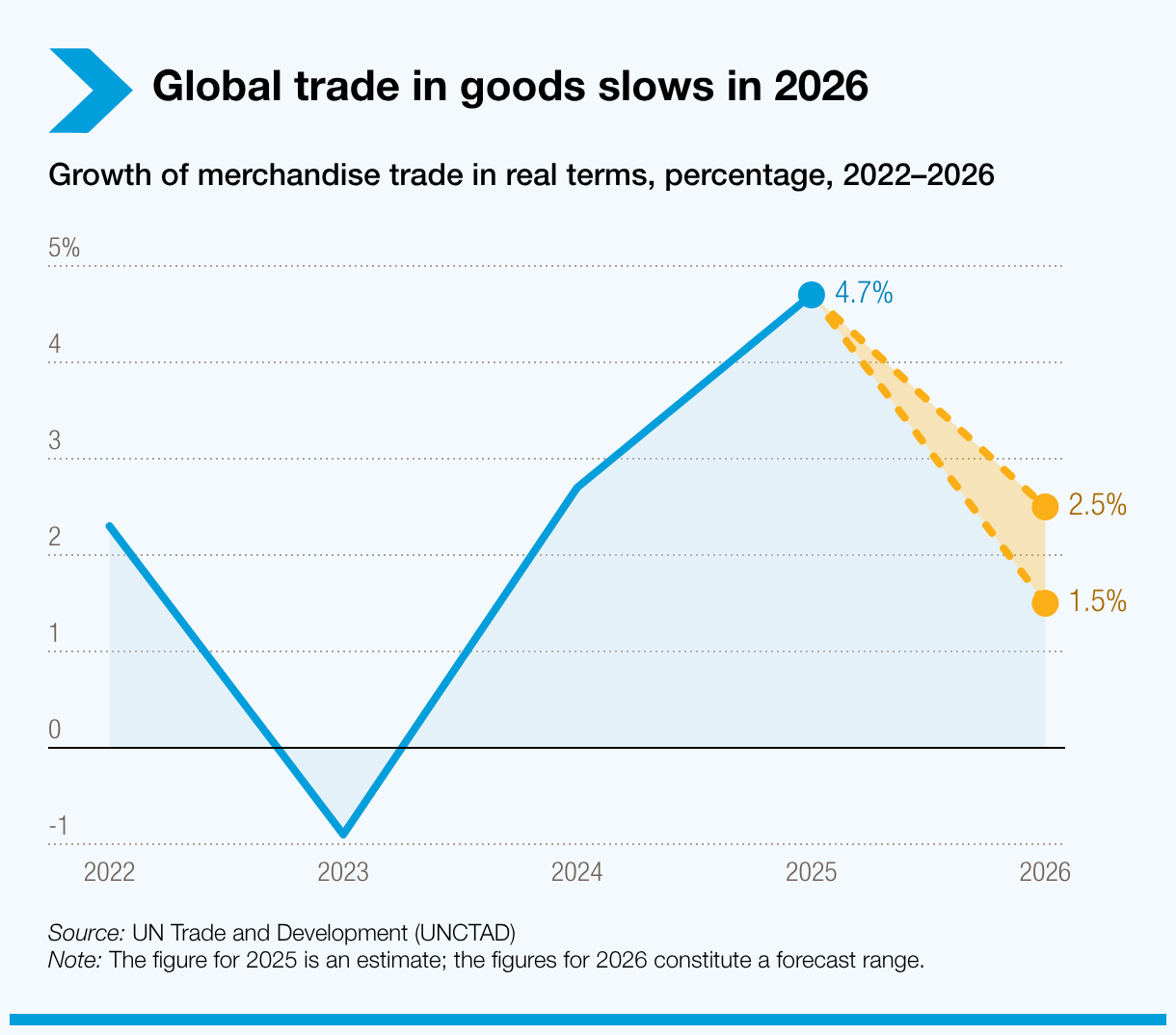
Worldwide merchandise trade growth is expected to fall by as many as 3.2 percentage points in 2026 compared to last year, according to UN researchers.
A report from UN Trade and Development (UNCTAD) exploring what the second half of 2026 might hold said trade uncertainty and geopolitical tensions are weighing on supply chains, shipping and investment decisions.
As a result, global goods trade growth could drop from 4.7% in 2025 to between 1.5% and 2.5% this year. This would be the lowest level of growth since 2023, when merchandise trade grew by just 0.9%.
Despite “relatively strong” trade in the initial weeks of 2026, fuelled partly by robust Chinese exports, UNCTAD said the outlook rapidly changed following the outbreak of military escalation in the Middle East in February.
In UNCTAD’s January global trade update, it had warned that governments are “expected to continue using tariffs as protectionist and strategic tools” in 2026, and that “uncertainty is likely to persist”.
Growth in goods trade has also largely been concentrated in products linked to the AI boom, such as semiconductors and servers, it noted in its latest report.
Last year, automatic data processing machines accounted for around 75% of nominal import growth in the US.
Overall, UNCTAD predicted that global growth will slow from 2.9% in 2025 to 2.6% in 2026, driven by “higher energy prices, transport disruptions, market volatility and [the] search for financial safe assets”.
While the global economy showed resilience at the beginning of the year, “rising geopolitical tensions are now testing that momentum”.
The report said that geopolitical risks are supplanting trade policy tensions and uncertainty as the main source of instability for the global economy.
The impact of continued instability on trade in developing economies, alongside rising costs, currency pressure and more stringent financing conditions, is also undermining growth, UNCTAD said.
Global food trading systems are also under pressure from volatility and more constrained financing conditions, the report noted.
“Financial stress among major food trading firms could amplify food security risks if disruptions persist, adding pressure on governments already facing limited fiscal space,” UNCTAD said.
“Food security is no longer only about availability and prices. It is increasingly also a financial stability concern, especially for governments already facing higher debt-servicing costs.”
Disruption caused by the closure of the Strait of Hormuz is impacting developing economies that rely on imported food, fuels and fertiliser, while developing country currencies have weakened against the dollar and emerging market equities have fallen.
GTR reported earlier this month that some African nations will face more acute fiscal pressure, and the risk of sovereign defaults may increase, if the Strait of Hormuz stays closed for longer.
To build resilience, UNCTAD flagged the need for “more predictable trade conditions, greater financial safeguards for developing economies and faster investment in affordable clean energy”.
“The global economy remains highly exposed to geopolitical shocks, energy disruptions and financial instability,” the report noted.
UNCTAD also called for greater investment into clean energy, particularly on the African continent, which it said received just 2% of global clean energy investment in 2024, to build more stability.