

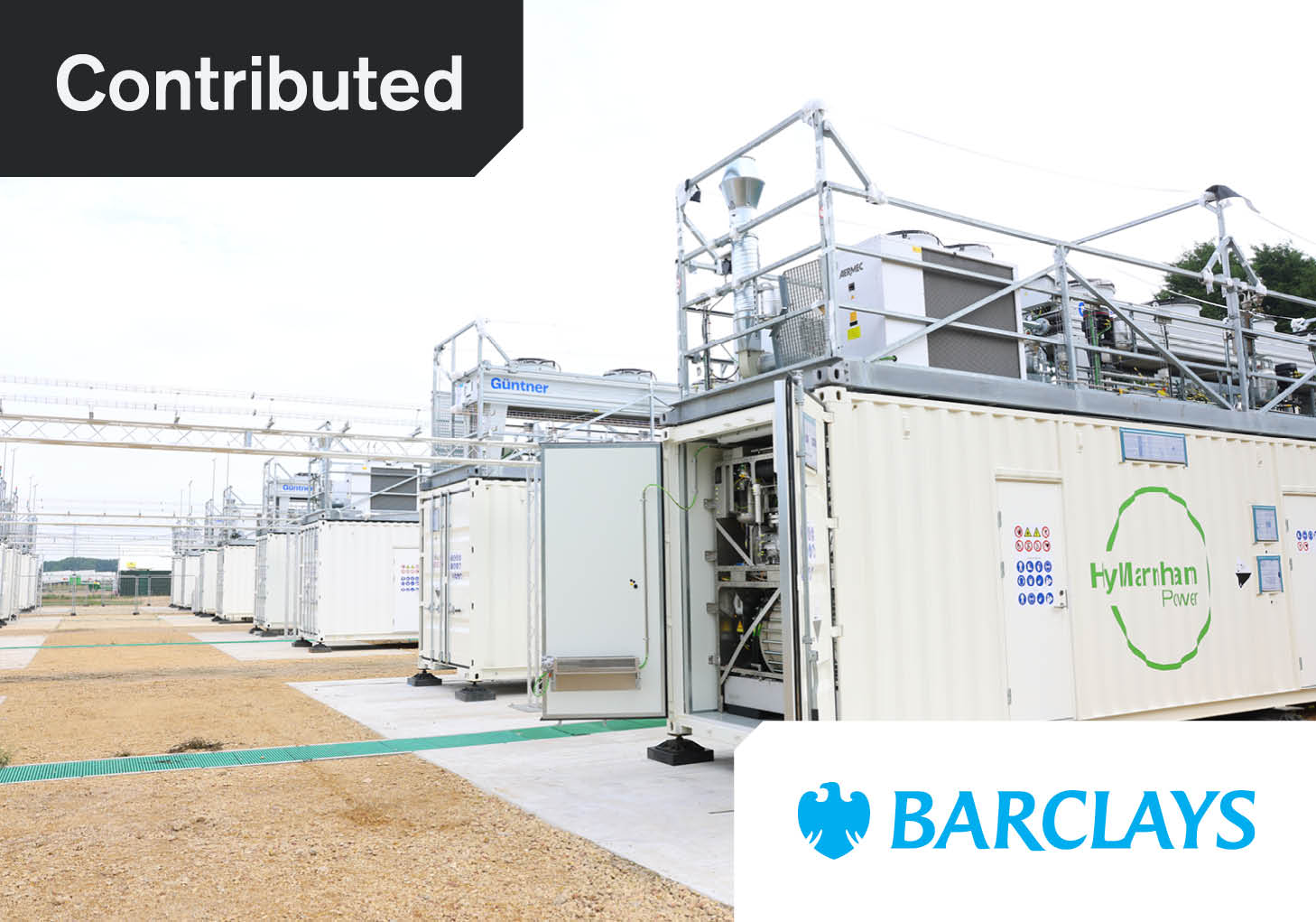
As transition ambitions meet commercial reality, Barclays is applying its trade finance expertise to mitigate risk and help support projects at scale. From hydrogen to renewables, the focus is moving from intent to practical, financeable execution.

The energy transition has entered its practical phase, with questions now facing corporates and their banking partners becoming more concrete: how will power be generated, who bears the risk, and how does sustainable finance keep pace as the technology is still proving itself?
Across trade-exposed sectors, demand for transition finance is mainly driven by large, established businesses managing change within existing traditional balance sheets. Heavy industry, energy, infrastructure and real estate-linked supply chains dominate the conversation.
“Sustainability, when it’s not your core business, is normally the domain of the largest corporates,” says Marco DeBenedictis, head of sustainable finance at Barclays Corporate Banking. “Incumbent companies with balance sheets constructed over decades are where we see this most clearly, however there are opportunities in younger companies too.”
Few are reinventing themselves overnight. But most are being forced to engage as regulation tightens, customers ask harder questions and capital allocation decisions increasingly reflect future-readiness rather than historical returns. Businesses with the largest scale and access to the most resources have the most levers.
Alongside this sits a newer pressure point: digitalisation-driven energy demand. Artificial intelligence (AI) may be framed as a software story, but its energy consumption is now firmly part of the transition conversation. This opens up more opportunities for younger, more agile businesses that are less reliant on legacy systems and processes.
“You cannot extricate energy transition, AI and sustainability. It’s all linked together,” says DeBenedictis.
Where policy meets execution
That same logic is also turning up in trade rules. For example, the European Union’s Carbon Border Adjustment Mechanism (CBAM) is prompting companies to reassess supply chains and embedded emissions.
“CBAM is one of the key regulations coming up in trade conversations,” says Jaya Vohra, global head of trade and working capital at Barclays Corporate Banking. “It changes how companies think about sourcing and pricing when goods come into Europe.”
CBAM sits alongside broader European reporting frameworks, including the Corporate Sustainability Reporting Directive, which continues to evolve as regulators search for a workable balance between transparency and implementation burden. The direction of travel is clear and unchanged, even if the rules themselves are still moving.
From a corporate perspective, however, regulation is rarely decisive on its own. Contracts often determine whether transition ambition translates into revenue that investors and lenders can underwrite. For example, government procurement can be decisive, particularly in infrastructure, where tender requirements can catalyse early demand for cleaner energy.
“Commercial traction is really important for businesses, firstly to grow, but also to attract capital and interest,” says Derek Bulmer, CFO at GeoPura, a UK-based green energy supplier.
When public projects bake cleaner energy requirements into tenders, they create demand certainty that private capital can respond to.
That shift from regulation-led compliance to commercially driven incentives is subtle but important. It reframes the transition from a cost to be managed into an opportunity to compete for contracts, scale operations and attract funding.
Why trade finance shows up early
Transition finance is often discussed through the lens of bonds and long-term project funding. In practice, trade finance often arrives earlier, sitting at the intersection of supply chains, contracts and risk mitigation.
“Trade is one of the tangible, real-world areas where we can offer finance and make a difference,” says Vohra.
Trade instruments are directly tied to the movement of goods and services. When turbines, electrolysers or other transition equipment cross borders, financing is linked to a specific shipment. That clarity matters, particularly in sectors where corporate-level sustainability metrics can lag operational reality.
“Trade isn’t just about financing,” says Vohra. “It’s also about risk mitigation. Guarantees and letters of credit are fundamental to getting these projects moving.”
These tools allow counterparties to transact without absorbing the full risk upfront. For corporates operating in nascent markets, they shape working capital, cash flow and ultimately survival.

“Support can be tailored as clients move through different phases of the transition. You can carve out specific end uses or wrap financing around credible transition objectives.”
Jaya Vohra, Barclays
Transition in the real economy
One persistent misconception about sustainable finance is that only businesses exclusively focused on green or sustainable activities qualify. In reality, most corporates exist in a different category, with legacy assets alongside transition investments.
Banks increasingly take a sector-based view, assessing how asset bases generate cash today and how resilient they are to disruption. Management capability, revenue visibility and cost control remain central.
“Support can be tailored as clients move through different phases of the transition,” says Vohra. “A business doesn’t have to be 100% sustainable. You can carve out specific end uses or wrap financing around credible transition objectives.”
That flexibility matters as transition finance moves from pilot deals to viable, repeatable structures. Over-engineering risks slowing adoption.
“There’s a danger of creating complexity for its own sake,” says DeBenedictis. “The focus should be on reducing friction and enabling transition while maintaining robust standards.”
One unintended benefit of this process is discipline. Financing discussions encourage corporates to articulate their transition narratives clearly, aligning internal finance, sustainability and risk teams in the process.
Turning ambition into action
Looking ahead, the focus is on execution. “We need to keep building practical ways to support clients on their transition journeys,” says Vohra. “It’s about staying close and focusing on credible end uses.”
Early engagement remains critical in fast-moving sectors. Bringing specialists in at the outset can unlock options that disappear once a project reaches formal approval stages.
“When something is evolving quickly, you need to talk to the people who have the expertise,” says DeBenedictis. “That often means earlier conversations than clients expect.”
In that regard, relationships matter because they allow frank discussions about what is realistically achievable. Financing becomes a problem-solving exercise, not a product sale.
“It always comes back to having the right people around the table,” says Bulmer. “You explain what you’re trying to do, and you work out how to structure it.”
None of this gets simpler. Energy demand grows, technologies evolve, regulation shifts. What is changing is the market’s ability to turn ambition into a bankable proposition and scale transition from concept to reality.
A hydrogen deal in the real world
Green hydrogen illustrates the financing challenge facing many transition technologies. It is capital-intensive and still early in its commercial life cycle. Financing typically involves a mix of government support, export credit and bank funding, structured around assets and revenue streams with limited operating histories.
GeoPura’s late-2025 financing is a great example of how that alignment can work, blending a Barclays loan with a guarantee from Denmark’s export credit agency. The company has raised significant capital over the past three years, combining equity, convertible instruments and bank funding, supported by government programmes and export credit guarantees linked to imported equipment.
“Our 2025 deal was triggered by government allocation support, but it only worked because we could bring in export credit and structure the risk in a way banks could support,” says Derek Bulmer, CFO at GeoPura.
Execution risk remains a defining feature of emerging sectors. One key technology provider entered administration during the process, testing assumptions around timelines and counterparties.
“It’s easy to have great ideas,” Bulmer says. “The hard part is making sure they go long and become a business.”
Contract mechanics can also strain liquidity. Transition projects often involve large corporates or public bodies as early customers, but those contracts frequently require bonds that tie up capital.
“If you can’t get credit lines for those bonds, you end up tying up your own cash,” Bulmer notes. “That’s a real constraint.”
For banks, supporting the transition is not only about providing capital, but about structuring risk and aligning public and private capital so emerging businesses can scale amid uncertainty.