
A vast paper archive is being lovingly maintained in a private collection in Istanbul. It tells the story of the last 400 years of seaborne trade and traces the history of a document that remains the lifeblood of trade finance. But will it ever see the light of day?
Ahmet Aytoğan often lies awake at night, thinking about bills of lading.
The stalwart of Turkey’s shipping industry spends many hours trawling online auction sites in search of them. He also seeks out other trade artefacts such as charterparty agreements, letters of credit and insurance certificates.
Sometimes the nerve-wracking final minutes of an auction will take place in the wee hours at his home in Istanbul.
“I lose sleep in all scenarios,” Aytoğan says of his nocturnal bids. “If I win, I can’t sleep because I’m happy. If I lose, I can’t sleep because I just lost.”
The interrupted sleep is all in service of his hobby and life’s work. Over slightly more than three decades, the 62-year-old has amassed a trove of paper documents, including 1,200 bills of lading, spanning every inhabitable continent.
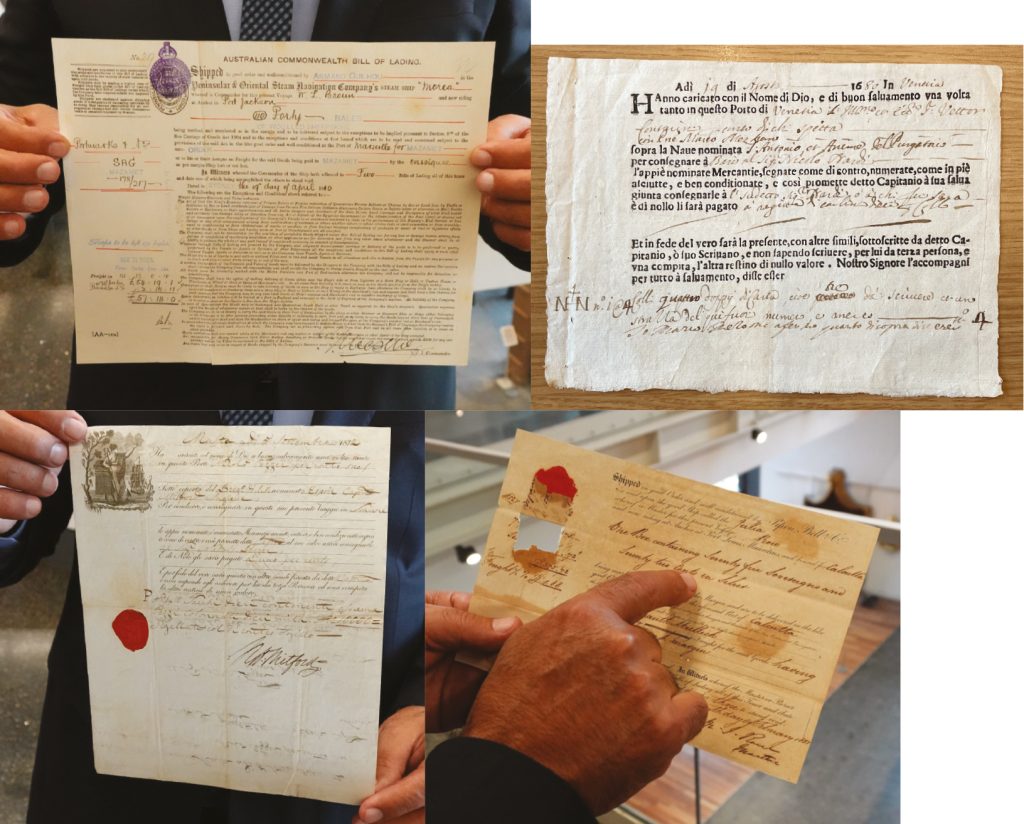
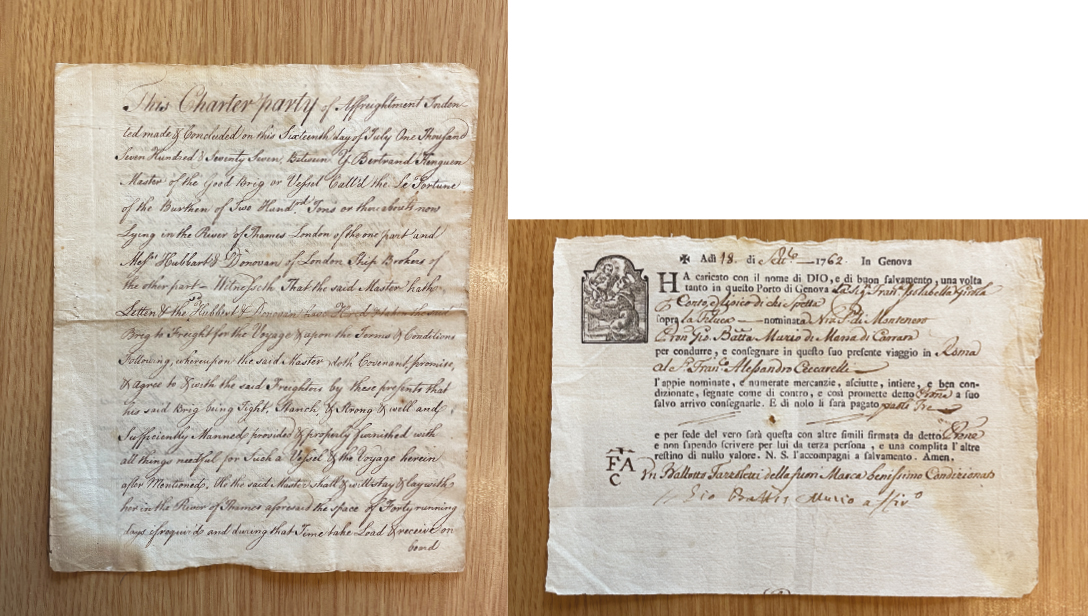
The oldest is from 1680, the year before King Louis XIV introduced a law stipulating that bills of lading be issued in triplicate – a practice that remains in effect to this day. Among the newest is a blank bill of lading issued by South Korean giant Hanjin Shipping, which went bankrupt in 2017.
The documents – some tattered, others remarkably pristine – tell the story of the arc of recent human experience. They bear the marks of almost four centuries of religious beliefs, colonialism, slavery and technological advancement.
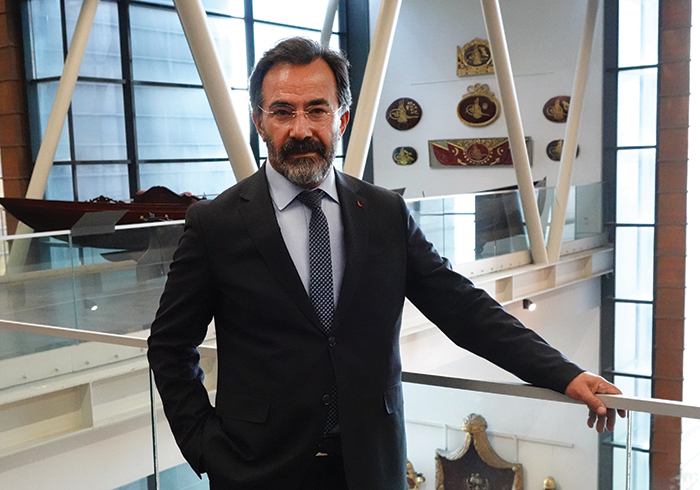
“There are the footprints of history, of humanity, of civilisation,” Aytoğan tells GTR in an interview in Istanbul, with translation help from his nephew Eren.
“I am sure that if those documents are thoroughly researched, some very interesting historical facts may come to light.”
Ahmet Aytoğan
A bill of lading from 1680 (top right), along with other bills of lading from the collection.
Aytoğan first developed a fascination with bills of lading while working as a documentation manager for a Turkish shipping company (a broader interest in the ocean can be traced back to his first sighting of it after a largely land-bound childhood in Anatolia).
He is now beginning the task of cataloguing and transcribing the documents. He highlights particularly interesting acquisitions in LinkedIn posts and YouTube videos, which garner interest from others in Turkey’s shipping and logistics sector. But he is hungry for the collection to gain a wider audience.
While Aytoğan has exhibited some of the artefacts in his home country, he believes the collection is a valuable repository for academic research, as well as of interest to global maritime centres.
“I want to open an exhibition in London,” he says. “If anyone thinks of maritime shipping in the world, they think of London.”
Michael Barrett, a fellow shipping document enthusiast from the Container Transport Alliance Australia who met Aytoğan last year, says “Ahmet’s collection is unique”, with “no other publicly available collections of these documents in the world”.
“The bill of lading represents not only a detailed record of a commercial transaction but also provides an entry door into a specific period of world history and an evolutionary marker towards present-day legal systems, cultural and political beliefs and commercial practices.”
God and Shakespeare
Scholars believe the first documents resembling the modern bill of lading emerged in the mid-16th century. They were short, crude slips of paper that attested to goods having been loaded onto a vessel, often at the behest of an individual rather than a company.
“112 bags of allam whiche goyth for tonne pype markyd with the marke in the margent to be delyveryd well condyshioned in the ryver of Themys,” reads one 1544 bill issued in Cádiz, Spain, cited in a 1983 academic paper.
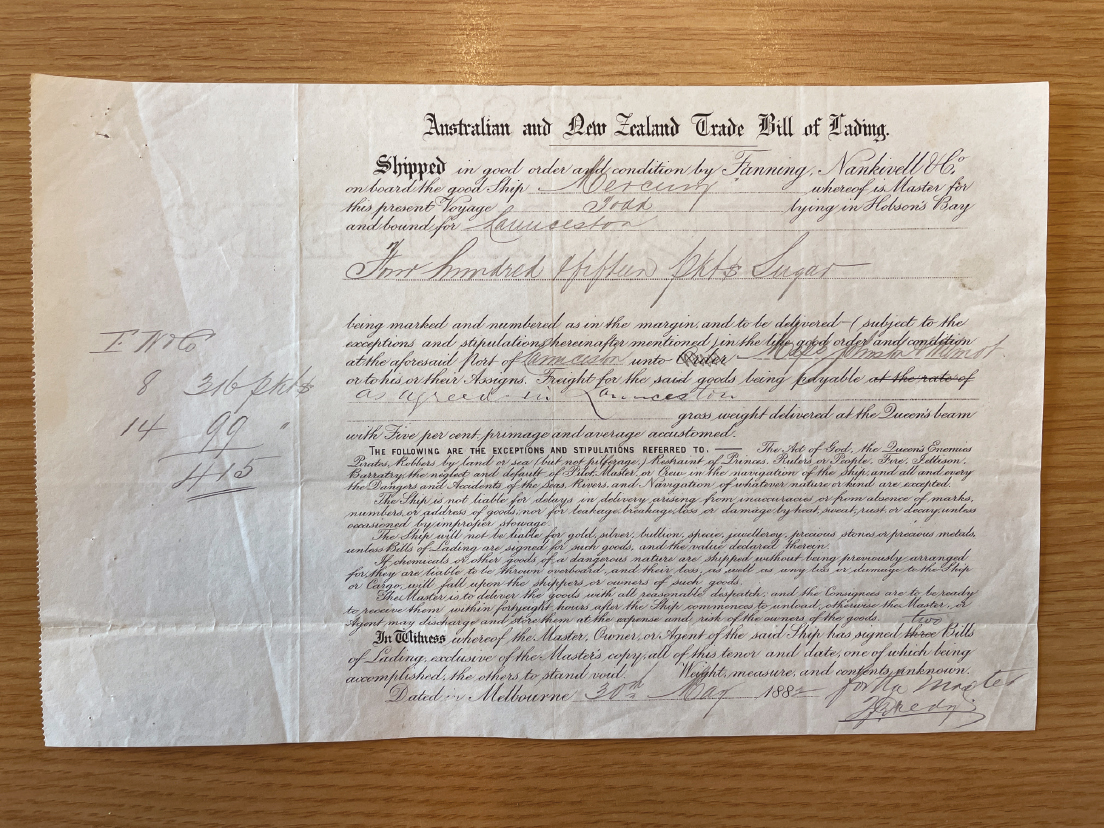
The documents remain essential to the global goods trade. They evolved to become a key instrument in trade finance by allowing lenders to own cargo during transit. Over the years, a voluminous body of law grew up around them, moulded by all manner of disputes, court cases and ever-evolving risks of the seas.
But Aytoğan believes that, despite its role in history, the bill of lading remains woefully understudied.
He argues the evolution of negligence clauses alone warrants investigation. Such clauses are designed to limit the carrier’s liability if cargo does not make it to port, or at least not in good enough condition.
Initially, these clauses constituted a breezy aside that promised safe passage, excepting only “the dangers of the sea”. Later, Aytoğan’s collection shows, “piratical robberies” was added as an exception. Over the years, they have mushroomed into long sentences in the modern bill of lading’s fine print, as well as being coded into law.
One of the most remarkable features of the selection of almost 100 documents that Aytoğan brings to the interview are the intricate illustrations that graced bills of lading for centuries. One such drawing, by a 19th-century Seville illustrator and printer, adorns Aytoğan’s business card.
The drawings were unique to each issuer of the bill of lading, partly to help establish the authenticity of the document – an issue that bedevils international trade to this day. But Aytoğan says the religious motifs apparent in so many of the drawings were a projection of the carrier’s values and imparted a sense of trust.
These religious figures began to fall away as the Industrial Revolution gathered pace. Similarly, phrases such as “shipped by the grace of God” or a simple “Amen” slowly disappeared as civil shipping law took the upper hand over the law of God.
Other documents, such as bills for goods being carried from the Caribbean to US ports, plainly show who sold, transported and purchased commodities produced by slaves (see box out).
For Aytoğan, the collection is a starting point rather than a finished work.
“There are some people spending great amounts of money. But there’s no one claiming to be a collector, with the ambition of opening an exhibition.”
Ahmet Aytoğan
“I alone am not capable of handling the entire collection in academic depth,” Aytoğan says. He likens himself to an archaeologist who digs up lost treasures, which then require study by experts.
“Hopefully, [it can be] handed over to social scientists and researchers. I am sure that if those documents are thoroughly researched, some very interesting historical facts may come to light.”
While the limited range of existing studies using bills of lading tends to focus on the evolution of maritime law, there are more surprising applications.
In 2015, the Folger Shakespeare Library in Washington, DC, purchased a 1623 bill of lading that described a consignment of nutmeg, cloves and calico being shipped from the River Thames to Venice.
The library used the document to interpret Shakespeare’s play The Merchant of Venice, with its researchers saying it helped put into perspective the enormous debt and risk taken on by Antonio, the merchant of the play’s title.
“The deal represented, from Antonio’s point of view, a reckless gamble of vast sums of money against a highly uncertain outcome,” the researchers wrote in 2022. “The nature of that gamble is made clear by the scrap of paper [the bill of lading] which has made the long journey through time and space, from seventeenth-century London to Venice, possibly back to London, and eventually to Washington DC.”
Barrett, the Australian shipping expert, says the “bill of lading has always had a unique ability to travel across geographic regions, countries, ports, cultures, legal systems, religious beliefs, social backgrounds, and language barriers”.
“Even a handwritten signature or notation on an old bill of lading provides a seductive clue as to who this person was and what type of personality they may have been in real life.”
A family tradition
Aytoğan’s collection had a modest birth. In 1992, he was gifted a bill of lading from one of the customers of Arkas Line, the Turkish shipping company where he worked for 18 years. Over the ensuing decades, his stockpile gradually swelled.
Collecting also runs in the family – his brother collects objects and documents from a system of schools for the poor that was shuttered by Turkish authorities in the 1950s.
Before the internet, Aytoğan would combine overseas work trips to cities like London and Stockholm with visits to dealers who came to know him and his arcane hobby. He was also given a large trove of bills of lading by a friend in Greece.
The provenance of many of the items he buys on the internet is not known, although he speculates many are put up for sale by relatives of people who worked in shipping or logistics.
“Out of the blue, a pile of documents arrives, and then suddenly they’re gone,” he says.
The hobby consumes a large part of Aytoğan’s time, particularly the extra research he undertakes to understand the context of individual items in his hoard. What free time remains is spent with family or playing music. His wife, Zeynep, is long-suffering but understanding, Aytoğan says.
“I’m so lucky to have her. Not everyone could put up with this kind of thing. If I were a woman married to such a man, I don’t know if I could tolerate this.”
His pursuit has also got costlier over the years. When he first started buying, a bill of lading would fetch US$10 or US$20. Nowadays, he says, they are “very expensive”.
A mid-December search of online marketplaces unearths relatively few bills of lading. On eBay, the most expensive is a 1778 document going for US$7,900. Bills of lading signed by US founding father John Hancock fetched up to US$1,800 at auction in 2013.
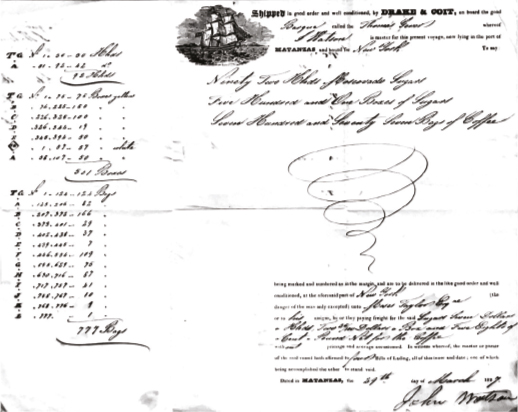
Among Aytoğan’s collection is an 1837 bill of lading for 92 packages of Muscovado sugar, 501 boxes of sugar and 777 bags of coffee, bound for New York from the province of Matanzas in Cuba. At the time, the vast majority of Cuban sugar exports were produced by slaves.
Upon arrival in New York, the goods were to be delivered to a man named Moses Taylor, the bill of lading shows. The same year, Taylor became a director and shareholder of National City Bank – one of the main predecessor entities to today’s Citi. According to research the bank conducted in 2023 on its links to slavery, from 1837 until his death in 1882, Taylor “utilised the bank as a private treasury for his own enterprises and required his companies to keep their principal accounts at City Bank of New York”.
The City Bank of New York was not mentioned on the bill of lading. But “Taylor himself, his business associates, and the firms they controlled supplied most of the bank’s deposits during this period”, according to Citi’s research, which found the “City Bank of New York likely profited indirectly from enslaved labour in Cuba by engaging in transactions with Taylor and his businesses”.
“There are some people spending great amounts of money,” Aytoğan says. “But there’s no one claiming to be a collector, with the ambition of opening an exhibition.”
After Aytoğan left Arkas in 2008, he spent 10 years at global shipping giant MSC. Now, he works as a consultant and trainer for companies in the trade sector, including banks. Fittingly, he also designs bills of lading for Turkish shipping companies and freight forwarders.
He seems to know everyone in the business. When we stroll down to the Istanbul Naval Museum – which, in 2014, hosted one of the only exhibitions of his collection – he is warmly greeted by a curator, and we are given free entry to take photos.
Surrounded by the evocative displays of Ottoman-era warships, it’s not hard to visualise a selection of Aytoğan’s artefacts being on display in one of the grand museums of past shipping powerhouses.
GTR contacted the National Maritime Museum in Greenwich, the UK’s premier collection of seafaring curiosities, to ask how the institution views the importance of the bill of lading.
Martin Solomon, an archivist, says the museum has a small collection of the documents, but they have seen “limited” use by researchers and museum audiences over the years.
Coincidentally, he mentioned, Aytoğan had approached the museum about the possibility of an exhibition just weeks earlier. But, Solomon says, “the exhibition and publications teams were similarly of the view that while receipts for cargoes are in many ways fascinating documents, this would appeal to a more specialist audience”.
So for now, Aytoğan’s wish to tell the story of the bill of lading remains unfulfilled.