
The Gulf’s rise as a strategic middle power and logistics hub, combined with Asia’s continued dominance in manufacturing and consumption, and the digitalisation of trade finance, are all converging to restructure the global trading landscape. But beyond the headlines, what’s actually changing?
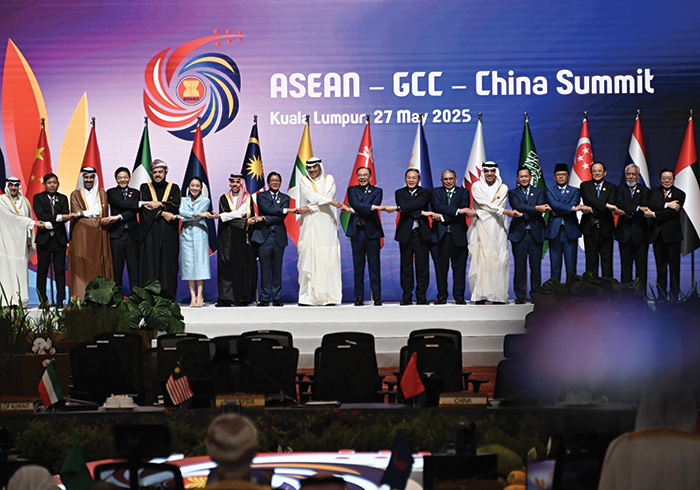
The old maps are being redrawn: amid rising protectionism and geopolitical fragmentation, ties between Gulf Cooperation Council countries and Asia have been quietly thriving. Trade between the two regions has surged to record heights in recent years, outpacing the Gulf’s trade with western economies – a turning point that signals not temporary disruption but a “structural re-ordering” of traditional trade corridors, according to London-based think tank Asia House.
Its November 2025 flagship report found that Gulf-Asia trade reached US$516bn in 2024, up 14.4% from the previous year and roughly double the value of Gulf-West trade (US$256bn).
Gulf and China trade alone rose to US$257bn, overtaking combined trade with the US, UK and eurozone for the first time. Meanwhile, bilateral flows between the Gulf and Southeast Asian nations (Asean) also strengthened, rising nearly 15% in 2024 to US$128bn, as new deals and multilateral forums cemented ties between the two regions.
“Asia House has been tracking the Middle East’s pivot to Asia over the last eight years, and in that time, we have seen the establishment of deeper economic, diplomatic and commercial relationships,” says the company’s CEO, Michael Lawrence. Logistics choices, risk frameworks and financing structures have materially shifted as a result.
But what is actually changing on the ground as the Gulf-Asia corridor expands? Where is trade genuinely growing, and how are banks, insurers and logistics providers adapting?
Trade corridors expand
While the bond between Asian and Gulf countries is long-standing, it has solidified “amid deep disruption to global trade”, says Asia House’s lead Middle East associate, Freddie Neve.
US$516bn: Gulf-Asia trade in 2024, up 14.4% year-on-year and roughly double Gulf-West trade (US$256bn).
US$802bn projected Gulf-Asia trade by 2030, with Asia set to become the Gulf’s largest trading bloc by 2028.
US$375bn expected Gulf- China trade by 2028.
US$175bn potential Gulf- Asean corridor by 2030.
Source: Asia House
Sriram Muthukrishnan, group head of transaction banking product management at Singapore’s DBS, agrees, noting that Asia and Middle East trade growth “in the last three to four years has been much stronger”.
On the one hand, tariff escalations have had “a fundamental impact on trading relationships, particularly with regard to the US-China dynamic”, explains Amanda Rasmussen, chief commercial officer at DHL Global Forwarding.
As China shifts its export focus to other markets, including Europe and the Middle East, the company’s cargo arm saw a surge in volumes from Asia to Latin America, the Middle East, North Africa and Türkiye of 20-35% throughout 2025, she says.
At the same time, Gulf-Asean trade is being shaped by efforts to spread risks and navigate tariffs, as companies rethink how and where they manufacture and source goods. “Customers are accelerating supply chain redesign, including dual sourcing in Asia, multi-country production footprints, and increased interest in India and Asean,” Rasmussen confirms.
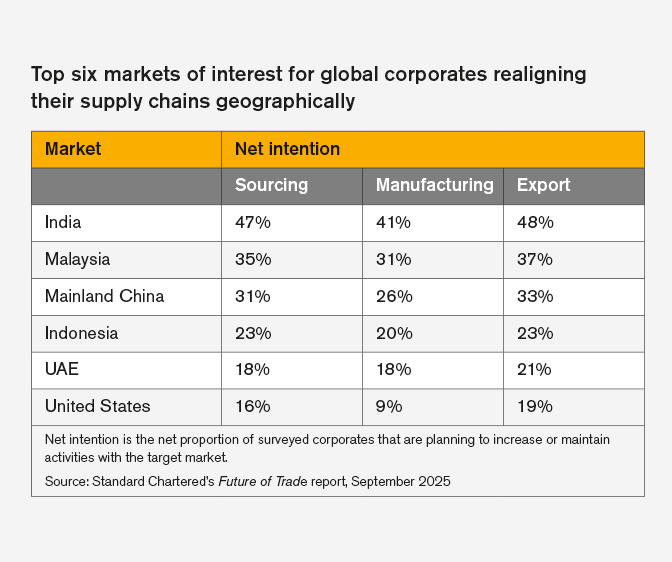
Research from Standard Chartered last September showed a growing focus among business leaders on Asia and the Middle East over the next three to five years (see table).
Beyond geopolitical fragmentation, the rise in Gulf and Asia trade is also linked to sector-specific investments, particularly in semiconductors, electric vehicles (EVs) and renewable energy, Rasmussen notes.
While energy has traditionally driven much of the trade volumes between the Middle East and Asia – with Asian demand for the Gulf’s largest export expected to continue growing up to 2050, as per Asia House – the two regions are also deepening their cooperation in non-oil sectors amid efforts to diversify regional economies.
For example, steel exports from China to the Middle East, “especially to Saudi Arabia, which is a big net importer”, are growing, Muthukrishnan says. And Chinese exports of EVs, batteries, and project and infrastructure to the Gulf region are also “rising fast”.
Meanwhile, Singapore – and by extension DBS, its largest bank by assets – “has an important role to play in the chips sector” as a producer of 11% of global semiconductor output, he notes.
Investments in the technology space are also pushing multinationals to diversify their output countries, Muthukrishnan says. “For example, EV factories are now coming up in Thailand and Malaysia, data centres across the whole of Asia… It’s not just a China-centric story anymore.”
Overall, the Gulf’s sovereign wealth funds deployed 40% of their estimated US$56bn total to Asia in the first nine months of 2025 – up 17% from the year before, according to Asia House.
The UAE is driving the Gulf’s trade with emerging Asian countries, bolstered by those sovereign wealth fund deployments, the UAE’s Comprehensive Economic Partnership Agreement programme, and growing interest from Asian investors and businesses.
“This reflects a long-term shift in capital allocation, as Gulf investors seek exposure to Asia’s growth opportunities,” Asia House’s report said.
Simultaneously, Asian financial services firms are expanding into the Gulf to “capitalise on its growing pools of sovereign and private wealth”. Financial institutions on both sides of the corridor are “preparing for a greater influx of capital in the future, with increasing collaboration between Asian and Gulf bourses”, the think tank said.
How trade finance is adapting
As global supply chains morph, so does the financing that supports these new routes. Globally speaking, banks are reporting a shift away from traditional letters of credit (LCs), with documentary LCs down 2% year-on-year in 2025, according to Standard Chartered. Increasingly, lenders are favouring faster, more flexible instruments that can keep pace with evolving supply chains and modal shifts.
However, LCs are simultaneously finding new life in emerging corridors. UniCredit, for instance, has seen “renewed interest in oil-related LCs coming from India in favour of European commodity traders”, says Francesca Nenci, global head of trade and correspondent banking. “These kinds of flows have been inactive for the past few years and are recently revamping.”
Deutsche Bank reports that China’s LC usage for Africa-bound exports jumped 28% in the first half of 2025, exceeding US$83bn, as exporters seek alternatives to US markets and manage risk in less familiar territories. Citi is also seeing a shift from open account to letters of credit “in an environment of heightened geopolitical risk”.
Nevertheless, open account terms still make up roughly 80% of global trade. Supply chain finance volumes are set to grow from US$8.7bn in 2024 to a projected US$9.5bn in 2025, says Anand Jha, Deutsche Bank’s global head of trade finance for financial institutions and regional head of trade lending for the Middle East and Africa.
The most prevalent product shift has been the growth of inventory finance, driven by companies building buffer stock and transitioning from just-in-time to just-in-case models amid geopolitical turbulence.
DBS Bank’s inventory finance book doubled in 2025 alone, with more than 50% of the growth coming from European and Western corporates with Asian operations.
In the tech space specifically, “purchases for data centres are very high value”, explains Muthukrishnan. “Clients are asking us to finance the inventory holding period during manufacturing. We can follow the value chain from buyer to intermediate manufacturer to end buyer, structuring a solution to relieve balance sheets.”
Meanwhile, shifting from mostly sea freight to air and multimodal “means clients are asking for shorter-tenor financing solutions to match the quicker turnover of goods”, notes Citi’s head of trade and working capital sales, Middle East and Africa, Marcelo Moulin.
This includes financing for expedited shipments of pharmaceuticals, hi-tech components and perishable goods.
The Asia-Gulf corridor is also pioneering currency diversification. According to Asia House, trade in renminbi could pick up as firms in the corridor seek greater efficiency. DBS, as the first Singaporean bank to join China’s SIPS payment system in 2015, already reports growing use of renminbi for Gulf-Asia energy trades.
And off the back of this trade boom, DBS has now “built capabilities and partnerships to serve these corridors, including strategic partnerships with FAB in Abu Dhabi and BSF Bank in Saudi Arabia, as well as payment linkages with fintechs Nium and Banking Circle”, Muthukrishnan says.
Simultaneously, European corporates are establishing regional treasury centres in Singapore, Hong Kong and India’s emerging Gift City to build “localised liquidity pools supporting supply chain realignments”, he adds.
“Another trend we are witnessing is corporates creating joint ventures with original equipment manufacturers to drive strategic alignment on procurement and to enhance their ability to raise capital,” notes Sofia Hammoucha, global head of trade and working capital at Standard Chartered. “In some cases, these joint ventures are also set up between competitors to reduce the initial costs.”
Risk, compliance and underwriting headaches
The surge in Gulf-Asia trade means flows are diversifying into unfamiliar territory, creating a more complex risk landscape for banks, insurers and companies alike.
In the Middle East, escalating geopolitical tensions are a key concern for DBS, says Muthukrishnan.
“Our operational posture is adjusted cautiously in response to elevated geopolitical tensions, including direct military threats.”
Marcelo Moulin, Citi
“Given the geopolitical situation, we must keep operations and client-facing teams aware of changing regulatory and sanctions requirements,” he says. “In well-regulated markets like the EU, it’s easier. Newer markets are more challenging.”
Citi’s Moulin also concedes “disruptions have significantly influenced our risk appetite”, saying: “We maintain a zero-tolerance approach to sanctions risk. Our operational posture is adjusted cautiously in response to elevated geopolitical tensions, including direct military threats, and we meticulously evaluate the evolving landscape concerning international trade policies and tariffs.”
In Asia, risk perception is still “extremely fragmented”, Muthukrishnan says. Countries like Singapore, China and Korea have strong credit ratings, India has been upgraded and others “are still coming up the credit curve”.
Risk underwriting in newer hubs like Vietnam “is more differentiated versus established markets”, Deutsche Bank’s Jha confirms, and relies on “country-specific risk frameworks, data-heavy assessments and innovative financing structures”.
Physical security concerns are also mounting alongside financial risks. Research last year by TT Club, an insurance provider for the international transport and logistics industry, revealed that 76% of cargo thefts in the Gulf occur in storage facilities, with the highest concentrations in the UAE and Saudi Arabia.
“We’re continuing to see the emergence of new risk profiles – particularly across the China and Asean-to-Gulf trading corridor,” says Mike Yarwood, managing director of loss prevention at TT Club. Operators switching to unfamiliar hubs report “increased documentary checks, inconsistent security protocols, and delayed clearances”, he warns.
A November 2025 Allianz report also underscored the infrastructure challenge, noting Gulf “midway hubs act as efficiency anchors yet remain vulnerable to political and environmental stress”, while Asian hubs “lead on capacity and reliability but face mounting political risk”.
DHL’s Rasmussen concedes there are “infrastructure and customs bottlenecks in newer corridors”, but says the potential is still immense, as long as there is “sophisticated risk and regulatory management” alongside capital deployment, increased security for high-value cargo like pharma and tech, and better end-to-end visibility across multimodal routes.
For global businesses, the current risk environment in the Middle East highlights “the need for proactive risk management”, says Aon’s chief commercial officer in the Middle East, Jord Oostrom.
Companies should therefore continue “monitoring alternative routes and logistical exposure” and “leveraging real-time intelligence and close broker support to make responsive decisions”, he says.
Technology is playing a key role in addressing the risk and compliance challenges linked to the corridor’s complexity.
Standard Chartered’s Trade Track-It portal, launched in 2022, allows companies to track their transactions, document delivery and vessel status, as well as the geo-location and movements of their trade-linked ocean shipments via Lloyds’ sea-searcher tool. This allows for near real-time visibility and better planning, Hammoucha explains.
UniCredit similarly deploys vessel tracking data to monitor ship locations and estimated arrival times.
GPS data from high-value cargo shipments “can trigger payment upon arrival at specific milestones, reducing overall risk and improving efficiency”, notes Citi’s Moulin. This is particularly valuable for Gulf transshipment hubs handling large Asia-Europe flows.
Meanwhile, electronic documentation is accelerating settlement cycles. DBS reports successfully using electronic bills of lading (eBLs) to finance goods in transit in new corridors.
The International Chamber of Commerce (ICC) UK claims that “eBLs and e-invoices can cut processing times by up to 99% and settlement cycles by 75%”.
These tools point to a broader shift: trade finance is moving beyond digitising paperwork to embedding live logistics data directly into funding and risk decisions.
“We’re continuing to see the emergence of new risk profiles – particularly across the China and Asean-to-Gulf trading corridor.”
Mike Yarwood, TT Club
“Real-time logistics data, GPS, internet of things sensors, digital customs declarations and AI-driven verification are now central to both operational resilience and financial decision-making,” says ICC UK secretary general Chris Southworth.
Companies are “re-focusing finance operations to reduce the impact of fluctuating foreign exchange and interest rates” and “seeking to reduce regulatory risk”, he says, arguing “this integration of logistics data into financial workflows is the next frontier”.
“As corridors such as China/Asean-Gulf grow in strategic importance, such visibility is becoming a requirement rather than an optional enhancement,” Southworth says.
The Gulf’s logistics investments
To support rising Gulf-Asia trade flows, Gulf states are investing in major infrastructure projects, including regional ports, warehousing, rail links and air cargo facilities.
In 2024, Qatar Airways Cargo ordered 34 Boeing 777-8F freighters and added routes to Abu Dhabi, Sharjah, London Heathrow and Kuala Lumpur, plus increased frequencies to Hong Kong and China. DHL is also investing over €500mn in Middle East logistics infrastructure by 2030, including aviation hubs and gateways.
Meanwhile, the UAE’s Jebel Ali port is positioning itself as a major transshipment hub with upgraded automation, and Saudi Arabia has launched a massive infrastructure build-out supporting its rise as a global trade powerhouse.
These investments are not only bolstering the Gulf’s role in shipping and logistics but creating the physical infrastructure that enables the flexibility companies exporting out of Asia now require – especially in light of the supply chain disruptions of recent years.
For instance, when the Red Sea shipping route was disrupted by Houthi attacks on commercial vessels, Maersk used ocean-air transport to ship Indian grapes to Dubai, then into European airports, because they lacked the shelf life for the longer Cape of Good Hope route.
“We are also seeing sustained interest in ‘portfolio-based’ transport planning, where customers deliberately split volumes across ocean, air, rail and multimodal to hedge geopolitical risk and rate volatility,” DHL’s Rasmussen says.
The logistics giant has also seen a growing use of air freight out of Asia, “particularly within sectors such as technology – needed for the rapid build-up of data centres for example, or in order to strengthen security and shorten transit times for high-value inventory – pharma and healthcare”, as well as “automotive, especially EV components, to avoid production delays”.
E-commerce, particularly in areas such as fast fashion and consumer goods, also “continues to make active use of air freight”.
Reshaping global relations
The evolution of Gulf-Asia trade is undeniably attracting capital deployment across specific hubs that banks view as structural rather than temporary.
Looking ahead, India dominates projections, with Standard Chartered identifying it as the top market for sourcing, manufacturing and export, while DBS’s Muthukrishnan also notes its large domestic consumption potential.
Asean manufacturing centres appear in every bank’s forward strategy, with Deutsche Bank highlighting “Vietnam and Indonesia as emerging manufacturing hubs supported by trade finance and risk mitigation”.
DHL’s 2030 forecasts also point to a diversification of supply chains out of China and into markets such as Malaysia, Thailand and Vietnam.
In the Gulf, the UAE leads Allianz’s multimodal powerhouse ranking at number one, while Saudi Arabia climbs to number four “as lower tariffs and growing non-oil exports expand trade potential”.
The kingdom’s infrastructure build-out is also drawing Asian interest: “China, Korea and India have participated in infrastructure projects through engineering, procurement and construction contracting,” notes Muthukrishnan.
“Gone are the days when Asia was only the manufacturing post – it is now driving global growth, including demand and consumption,” he says.
The two regions’ growing proximity will therefore inevitably result in a “re-ordering of supply chains, investment flows and technology partnerships that will shape global growth for years to come”, Asia House’s Neve foresees.
Southworth agrees: “What we’re seeing in the Asia-Gulf corridor is a fundamental rewiring of global trade.”