
Defence contractors are facing a range of fresh risks, including over-reliance on China and the ongoing impact of tariff wars, as demand “skyrockets”, national spending leaps and supply chains are reshaped.
A report released today by Oxford Analytica and Willis, WTW’s broking arm, said that “lagging production and insufficient collaboration between countries” present challenges for the industry, even as defence procurement has surged following Russia’s invasion of Ukraine.
Titled Managing the new economic risks in the defence sector, the report is based on interviews with five external affairs and risk management professionals, representing defence manufacturers in Australia, Europe and North America.
Tariff wars between China and the US ranked second among the top five risks, due to trade barriers disrupting supply chains and increasing costs.
Because defence manufacturing relies on semiconductor chips and critical materials such as rare earths, it is vulnerable to supply chain shocks – despite most defence equipment being exempt from tariffs.
“The combination of higher costs and tighter restrictions on access, especially because of US-China competition, creates a lot of uncertainty for the defence sector,” one European defence executive said.
Another potential risk highlighted by panellists was the impact of economic volatility driven by tariffs. “This trade war could slow growth, which would reduce governments’ fiscal capacity,” one expert said.
Many European countries have been bolstering their armed forces in response to Russia’s aggression and doubts over the US’ commitment to Nato.
Sam Wilkin, director of political risk analytics at Willis, noted that the late 1990s and early 2000s were “an era of extraordinary geopolitical stability, when conflicts involving states had dwindled to historic lows”.
“Today, that stability has vanished. Non‑state actors remain disruptive, but the last few years have been shaped by the return of state‑sponsored violence,” Wilkin said.
“These threats occur on a much larger scale and therefore have driven a surge in defence procurement and a reshaping of global defence supply chains. For companies active in the sector, this shift in the risk landscape has strong implications for operations and future planning.”
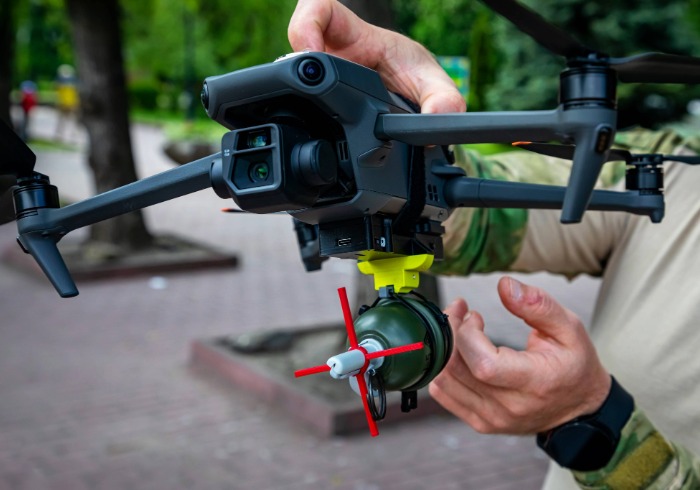
Dependence on China was highlighted as a key risk, especially for drone technologies and critical minerals like titanium, the report said.
This has been reflected in recent moves to prevent over-reliance on China, such as the UK’s export credit agency launching a guarantee to bolster Britain’s critical minerals supply chains amid intensifying competition from China.
One interviewee noted that the war in Ukraine had underlined how much equipment “relied on raw materials from China and Russia”.
A European executive said: “There’s significant dependence on Chinese-made components: electric motors, windings [and] control boards. Even now, in Ukraine, we’re seeing that most fibre-optic cable [used to control jamming-resistant Ukrainian drones] still comes from China.”
Another panellist added that “any tension” in East Asia would have “serious ripple effects” for their firm, given its reliance on electronics from the region.
The report also flagged the trade-off between nations pooling defence resources and maintaining national control as a major risk.
Interviewees pointed to new EU defence funding that has been reserved for European firms to counteract the fact that most of its spending currently goes on US products. “That could mean paying more for less capable systems,” a panellist based in North America said.
Insurance opportunities
Salomon Journo, head of Willis Credit Risk Solutions, France, emphasised the “dramatic shift” in the role of trade credit insurance since the outbreak of war in 2022, as underwriters have flocked to support the defence sector.
“We’re in a period of strong government support for the defence sector. This has softened the market a bit and made it a good market for buyers as a result,” Journo said.
Firms are now taking out insurance on European buyers of defence equipment or EU-financed deals, he added, despite this being rare in the past.
“The margins are good enough to support buying the cover, and everyone understands that political and payment conditions can change rapidly.”
The final two risks for the defence sector, the report said, were phantom spending, where political promises to increase defence budgets do not materialise, and western nations’ failure to reindustrialise.
Panellists also highlighted the risk of a “social backlash against defence spending and looming fiscal crises”, as debt-to-GDP ratios rise above 100% in some countries in Europe and North America.
The report made the case for political risk insurance as a “vital tool” for the defence sector. At the end of last year, GTR reported that political risk was dominating boardroom agendas thanks to trade tensions, wars and populism.