

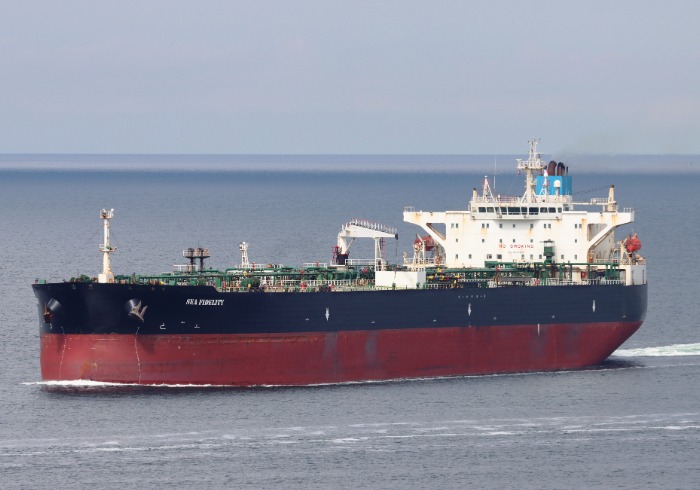
Over 100 Russian “shadow vessels” transporting €4.7bn worth of oil were spotted flying false flags to bypass sanctions in the first three quarters of 2025, a report has found.
According to Helsinki-based think tank, the Centre for Research on Energy and Clean Air (Crea), a total of 113 so-called shadow vessels – ships typically used to conceal the transport of sanctioned goods – carrying 11 million tonnes of Russian crude have flown a false flag in the first nine months of the year.
False flagging happens when a ship either registers with fraudulent or non-existent flag states, uses a terminated flag registration or digitally misrepresents their flag to obfuscate their operations, per International Maritime Organization (IMO) guidelines.
Along with flag hopping, or the practice of a vessel frequently and repeatedly changing its country of registration, these tactics have become common among sanctioned shippers to avoid scrutiny and skirt sanctions since Moscow’s invasion of Ukraine in 2022.
“The number of Russian shadow tankers sailing under false flags is now increasing at an alarming rate,” said Luke Wickenden, Crea’s energy analyst and co-author of the report.
“False flagged vessels carried €1.4bn worth of Russian crude oil and oil products through the Danish Straits in September alone.”
Crea’s latest report, published on November 27, investigated the “growing trend” of false flag operations, as well as the behaviour of currently sanctioned vessels and the emergence of new tactics employed by the shadow fleet carrying Russian crude.
In September 2025, there were 90 Russian shadow vessels using unauthorised flags, a six-fold increase from December 2024, the think tank found.
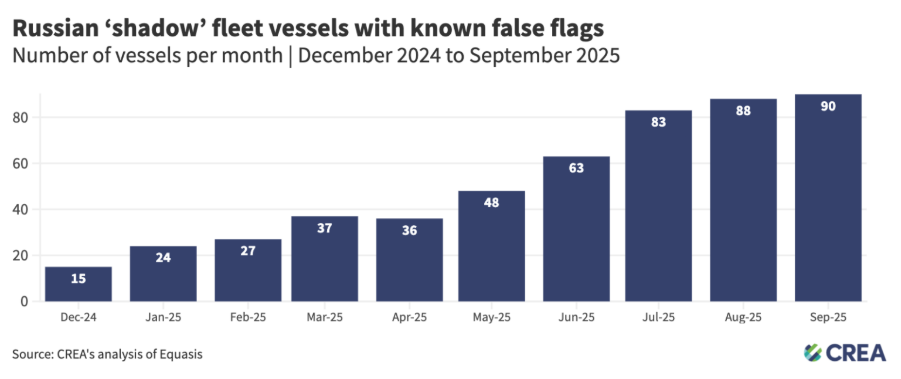
False flagging was most common in officially sanctioned vessels, with 96 ships under US, UK or EU sanctions having used this tactic at least once from the start of the year until the end of September 2025, according to Crea’s analysis.
The unauthorised flags of twenty countries have been used by shadow vessels, including countries which either do not offer ship registration services, or have actively denied flagging shadow vessels and have deregistered them post sanctions.
Crea found the most frequently used false flag is that of Malawi – a land-locked country which does not have a government body that registers ships and assigns them a state flag.
Since the first case in June 2025, 24 vessels – all of which are sanctioned – have flown Malawi’s flag while carrying Russian oil, the group said.
The Malawian Secretary for Transport and Public Works wrote to the IMO in July asking for “appropriate action to be taken against the fraudsters”.
Meanwhile, six flag registries that had not registered a Russian oil vessel prior to the Ukraine invasion had at least 10 such vessels each in their fleet in September 2025, according to Crea.
Additionally, 134 vessels have shifted their flag registry once within three months of being sanctioned by the EU, the US, or the UK, showcasing “a new market of operators willing to take the risk in absence of traditional registries”, the Finnish think tank claimed.
Crea EU-Russia analyst and co-author of the report, Vaibhav Raghunandan, said the group was increasingly seeing “shadow vessel operators taking advantage of capacity limitations of economically weak nations to exploit their flags and existing regulations to gain passage rights to deliver blood oil”.
He also warned “the insurance of any vessel flying a false flag is void, which, combined with the fact that a lot of these tankers are old and have been re-commissioned almost from scrap, increases risk for coastal states which fall on their routes, in the event of accidents or an oil spill”.
For its latest report, the energy research centre analysed vessel ownership data and flag registry records provided by Equasis and the IMO, along with commodity flows and customs data used in its own Russia fossil fuel tracker.
Crea has urged international policymakers to reform flag state regulations, provide support to build capacity for flag registries, and amp up surveillance and detentions of falsely flagged vessels.
These efforts would “disrupt Russian oil export logistics, increase costs and create delays, ultimately reducing the volume and reliability of its oil trade that finances the war on Ukraine”, the energy think tank said.
Crea’s policy recommendations:
- A unified EU database of legitimate flag registries shared between port authorities
- Require flag certification for vessels transiting EU waters
- Expand engagement with and within open registries to tighten net for shadow fleet
- Reform existing flag registration norms
- EU coastal maritime enforcement authorities, the UK Maritime and Coastguard Agency and the Royal Navy must detain shadow fleet vessels operating under false flags