


Hosted on the sidelines of GTR US 2025 in New York, senior industry figures discussed the impact of Liberation Day tariffs, ways to bolster the credit and political risk insurance talent pipeline and how to improve market penetration in the US.
Roundtable participants:
- Garret Glassman, head of credit and political risk solutions, US and Canada, The Hartford
- David Kinzel, USA practice leader, structured credit and political risk insurance, Aon
- Michael Kornblau, North American credit specialties, Marsh
- Paul Kunzer, global head of short-term trade solutions, Liberty Mutual Insurance
- Todd Lynady, regional head of credit risk solutions, North America, WTW
- Sarah Murrow, Americas chief executive, Allianz Trade (chair)
- Arjan Van de Wall, head of trade credit and political risk – Americas, Markel
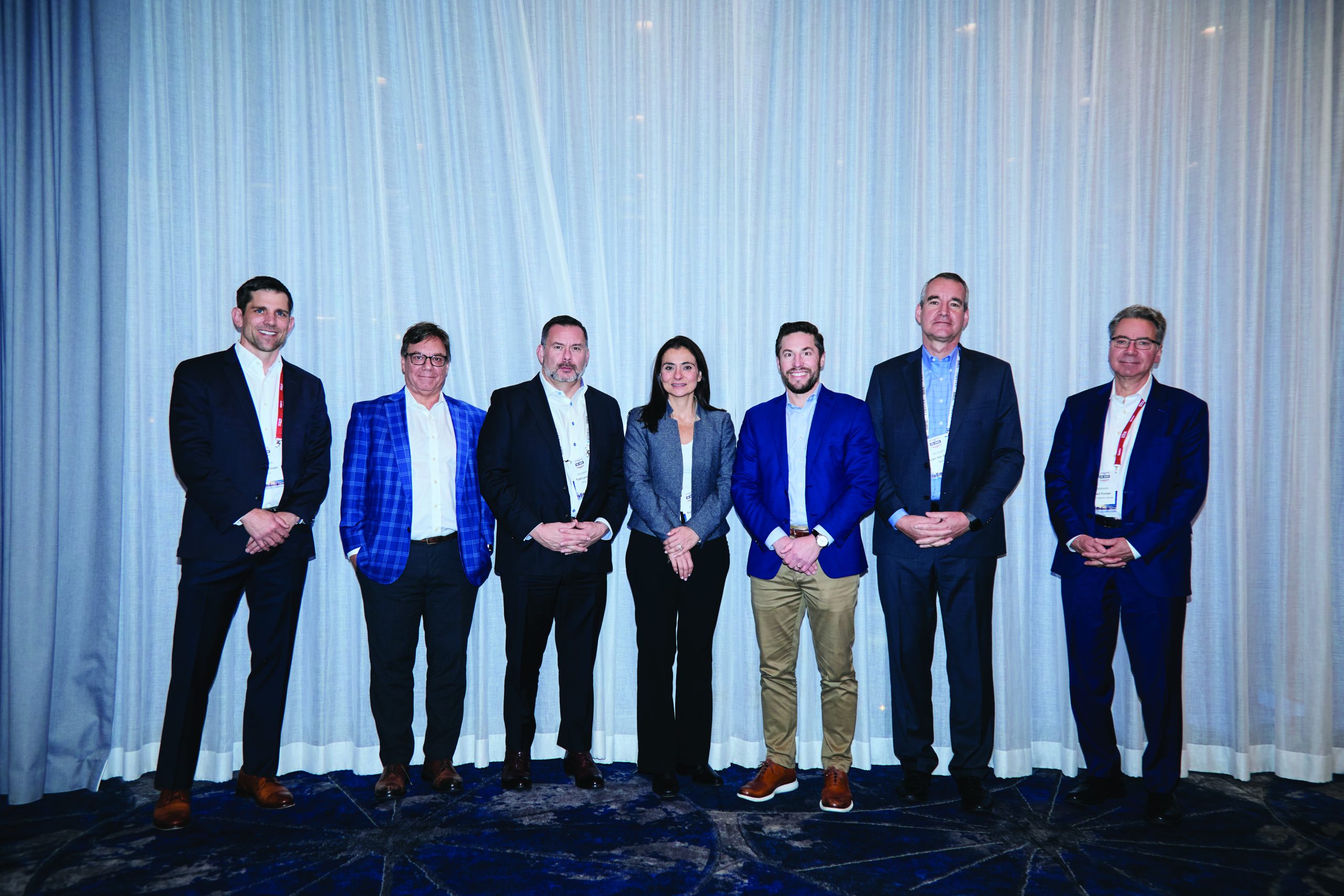
At the discussion in early December 2025, senior insurance sector figures weighed in on how the US economic landscape is reshaping risk appetites, as well as the challenges of selling credit and political risk insurance (CPRI) to the US market.
Top of the agenda were inflation and tariffs, while participants also discussed the ongoing uncertainty over the Basel III Endgame package and the major role of banks in driving demand for trade credit insurance. There was general agreement, too, that the sector could do more to attract fresh talent and promote itself as an appealing career path to recent graduates.
Here are the main threads of the conversation:
Soft markets, reshaped appetites
Speaking nine months after the US government’s announcement of its ‘Liberation Day’ tariffs, participants said the dust was beginning to settle at last and that the CPRI sector was taking a measured approach.
The Hartford’s Garret Glassman kicked off the discussion, explaining that the insurer has responded pragmatically to the new tariffs. “The news created some uncertainty with regard to who was going to be impacted the most, which sectors and what was to follow,” he said.
But in reality, changes have tended to be more moderate, and inflation has increased demand for trade credit, Glassman said.
“There’s still appetite and there’s still capacity in the market, despite all these headwinds.”
Paul Kunzer, Liberty Mutual Insurance
The auto sector has been challenged by inflation, he added: “Auto sector manufacturers are having to take over most of the tariff margins for their own account, not passing them through to consumers.”
Liberty Mutual’s Paul Kunzer was optimistic, noting that forecasts for the next year are broadly positive. “There’s still appetite and there’s still capacity in the market, despite all these headwinds.”
Referring to a report produced by the International Credit Insurance & Surety Association (ICISA), Allianz Trade’s Sarah Murrow pointed out that “between 2023 and 2024 the global trade credit insurance market, in terms of written premiums, shrank by 0.6%, while exposure grew by 7.5%”.
“We are definitely in a soft market,” she said. “I think it’s putting continued pressure on rates.”
Kunzer also highlighted the fact that losses have not materialised in any significant way. “When they start coming in, then we’ll see how the reinsurance market reacts to claims,” he added.
Markel’s Arjan Van de Wall noted that new entrants are continuing to move into the market, which shows “there’s clearly very high interest in this market. They wouldn’t do that if they saw something else on the horizon.”
Part of the underlying strength of the sector is its data.
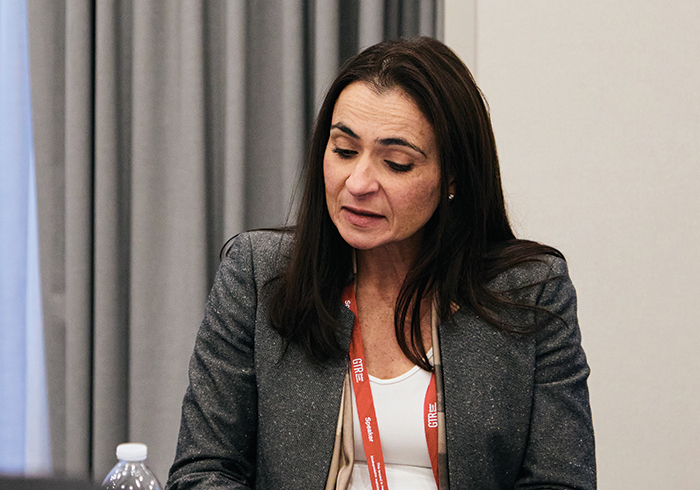
Looking back at the progress made by the CPRI market since the financial crisis in 2008, Marsh’s Michael Kornblau noted that the market has matured and developed better tools to assess risks, leaving it better equipped to deal with any downturns.
WTW’s Todd Lynady agreed with Glassman’s pragmatism and Kornblau’s point about new and improved tools. “I see a lot of the underwriters being much more pragmatic versus reactionary, like you saw in past challenging periods,” he said.
“Underwriters now have tools they can use to narrow down who they should focus on by asking, ‘who are my profitable clients? Who are my unprofitable clients?’”
Allianz Trade’s Murrow also flagged the vast improvements in available data since the financial crisis in 2008. Data today is far more granular.
“We can look at words in financial and annual reports to determine whether that would potentially trigger a review for a buyer. We’re more sophisticated now in our risk assessment,” Murrow said.
Market penetration
Although more and more firms are using trade credit in the US, the region still lags behind Europe and Asia, where uptake is growing rapidly.
But for Markel’s Van de Wall, the sector has “made major, major steps” in the last 30 years to penetrate the US market.
He pointed out the key disparities between the US and European markets – from cultural differences in approaches to risk-taking to variations in how distribution takes place. “Everyone in Europe needs to export,” he said, compared to US interstate trade.
“Americans are more willing to take risk. The Europeans are more risk averse,” he said. Another important difference is that “you can buy trade credit insurance on the high street in most cities in Europe”, Van de Wall added. “The banks are a major distributor of trade credit products.”
Allianz Trade’s Murrow drew the focus to the difference in provision for SMEs in the UK. “The majority of policies in the UK market are for SMEs. I would estimate 80% of those are required by banks or financial institutions,” she said.
“What I would love to see personally is the growth of multi-buyer, corporate business, because that is what is sustainable, and it’s how we grow the industry overall.”
Sarah Murrow, Allianz Trade
“It’s cultural in the financing and lending space – it’s completely normal. I believe it’s the banks that have the biggest impact to penetrate the SME layer.”
WTW’s Lynady agreed that the SME market is underserved in the US, and suggested there might be tools “that can make a lot of this self-service”.
“As a discretionary insurance product, with a longer-than-average sales cycle, it is very expensive to get into that market without automation tools – you have to make the product simple to buy and simple to use,” he added.
Turning their attention to the role played by trade credit insurance in unlocking financing in a high-interest rate environment, Kunzer said the interest from banks has “increased substantially over the time that I’ve been in this industry”.
“I think we’ve seen more growth in interest on the bank side than on the pure corporate side,” he added.
“Banks are the majority of our business at The Hartford,” Glassman concurred. “They’ve been driving significant demand across our market for the past 10-plus years.”
The dynamics of this are largely European and Asian banks looking for ways to optimise capital, but there is also a crucial element of risk mitigation, he said.
Credit insurance is enabling banks “to write larger tickets on deals, especially now we’re seeing the influx of AI and digital infrastructure”, Glassman said. “Data centre projects are massive in size and scope – the largest I’ve ever seen. We’ve come across projects that are US$20bn, US$30bn in size.”
Allianz Trade’s Murrow raised a point about wanting to see growth in the industry derive from a variety of client segments and sectors. “What I would love to see personally is the growth of both multi-buyer corporate business and bank business, because it’s how we grow the industry overall,” she said.
Aon’s Kinzel pointed out that banks were also lending to infrastructure projects, which come with “a lot of risks that can be picked up within the credit insurance market”.
“Offtake contracts and other contracts that are revenue flows within an infrastructure project, can, in some structures, be opportunities for the credit insurance market to provide support,” he said. These are areas that “continue to show promise within data centres, renewable energy and traditional energy”.
For “true multi-buyer corporate business” clients, Kinzel explained, it remains a “long game”.
“There needs to be a clearer communication of the value proposition for the industry,” he said. “When clients really understand and make use of the broader value of credit insurance, we often see them become longtime users. For many of them, the value of the cover extends well beyond the claims component.”
Building a talent pipeline
Despite concerted efforts by CPRI sector stakeholders in recent years to boost the industry’s profile and attract new talent, the group agreed that more could be done.
The Hartford’s Glassman explained that the insurer has been “investing heavily” in building underwriting strength across its global specialty lines.
“We developed an emerging underwriter programme, as well as summer associate programmes, to invest in those junior underwriters,” Glassman said.
“The talent we’ve been able to get across all of our lines, as well as CPRI, has been tremendous.”
Allianz Trade’s Murrow asked the group how their firms were maintaining underwriting judgement and industry knowledge transfer in hybrid working.
“Over the past 10 years, we’ve gone from largely office working to majority remote working. This raises questions for me on how we best support employees during the next downturn, particularly for those people who have never been through one,” she said.
WTW’s Lynady agreed. “Some of the younger talent have not been through a downturn, so they need more seasoned people to help them through and give them comfort by letting them know, ‘it’s going to be okay’.”
“I think we’ll see a shift [back to the office],” Lynady added. “The big banks are setting precedents.”
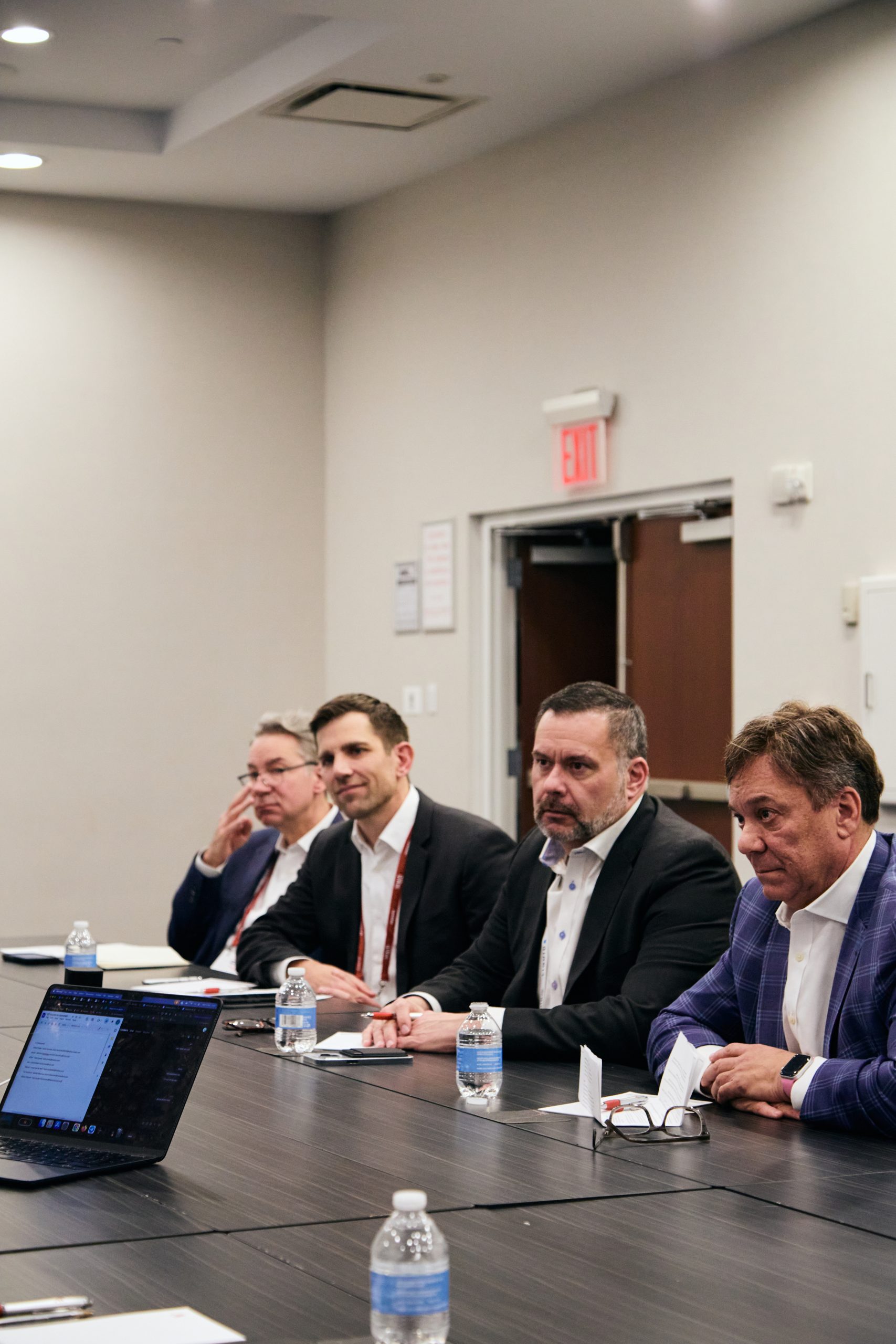
Sector collaboration
Regulation was also up for discussion, with Basel III top of most participants’ minds.
Marsh’s Kornblau pointed to the Basel III Endgame – the final set of rules governing global capital requirements, which are yet to be implemented by US regulators. “I think that’s going to be the primary driver for what happens to us as well. The state-by-state regulations don’t appear to be a monumentally changed environment. But I think the Endgame is the big one,” he said.
US federal regulation does not currently provide banks with capital relief when they use credit insurance. However, participants said regulators are being lobbied to include such relief in their implementation of Basel Endgame.
Kornblau also raised the impact of a potential uptick in private credit regulation following increased scrutiny on the sector. “That will be an important consideration for how much of that business we take up as well.”
On these points, The Hartford’s Glassman noted that “we’re all waiting very patiently” for clarity.
The efforts that have gone into lobbying for the value of credit insurance have been “unprecedented”, said Liberty Mutual’s Kunzer. “It’s something we should celebrate.”
WTW’s Lynady added that the credit insurance sector has had “high-profile people and entities waving the flag” during negotiations over Basel.
“We have the top banks in the US sitting there lobbying with us. They’re with us saying, ‘we need to have this. You’re putting us at a competitive disadvantage. Please do something for us.’ Hopefully that will start resonating,” Lynady said.
“15 years ago, syndication was a dirty word. Today, I think it’s the way to work together and to provide scalability and capacity for our clients and flexibility.”
Arjan Van de Wall, Markel
Discussing collaboration opportunities to grow the US trade credit sector, Markel’s Van de Wall said he had witnessed “an enormous change in the way we work together” in recent years.
“15 years ago, syndication was a dirty word,” he explained. “Today, I think it’s the way to work together and to provide scalability and capacity for our clients and flexibility.”
The Hartford’s Glassman added that “collaboration is the catalyst for scaling the business, creating those partnerships and driving awareness through education”.
Aon’s Kinzel also spoke about the opportunity for greater collaboration between insurers, brokers and lenders. “Even though we collaborate often, we’re still quite disconnected. We don’t always understand each other’s worlds,” he said.
“When people have a strong understanding of the broking, underwriting and banking worlds the whole system works a lot better.”