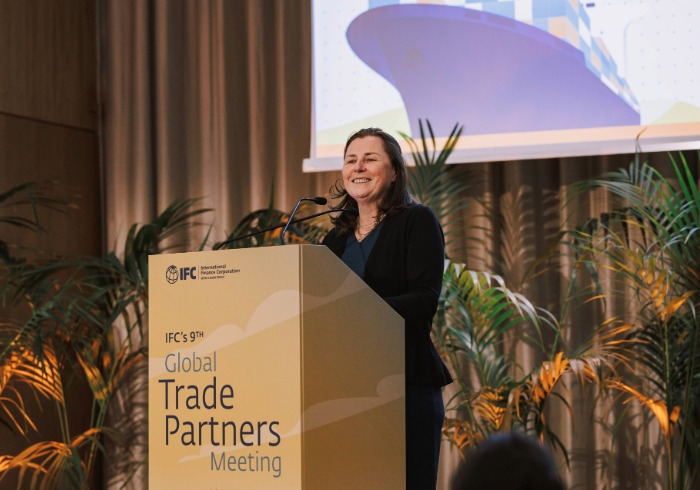



Sian Aspinall is the former group chief executive at specialist credit and political risk insurance (CPRI) broker BPL. She first worked at BPL as a broker in the early 1990s, then rejoined the firm as a technical director in 2014. She took the top job in 2022, overseeing a period in which BPL nearly doubled its gross written premiums.
Last year, Aspinall made the decision to step down in the first quarter of 2026 due to family health pressures, but continues to work with BPL as a non-executive director. Speaking to GTR at BPL’s offices in the City of London, Aspinall reflects on her career and the place of CPRI in the world today.
GTR: What led you to a career in credit and political risk insurance, and to BPL in particular?
Aspinall: I grew up in Rugby, a relatively small town dominated by the traditions of the famous school there. It was a very good window onto the social and economic divide that exists across the country. Coming through the grammar school system, you were always told that with hard work and a good education, you can overcome any of those barriers, and life is there for the taking.
I was very determined to work in the City. I did a business studies degree, and that had two industry placements for six months. One was with Investment Insurance International, which was the first political risk insurance broker in the London market. The subject matter was very interesting, though I found the culture quite intimidating. But it was very energised and it had a real life to it. Everything we did had a meaning and a reason.
They offered me a grad job for when I finished, and I moved to BPL within about a year. BPL had a very good reputation in the market for being a technical broker, which was appealing to me because I was very keen to learn my trade. I then moved over into the underwriting side for about 13 years. I really enjoyed the underwriting, but initially I found it very challenging. I used to review my decisions every night, working through risks in my head to check that I shouldn’t have done it differently or couldn’t have done it better.
GTR: Elsewhere you’ve spoken about the role played by class in insurance, as well as it being incredibly male dominated. How has the sector changed over the years?
Aspinall: There were a lot of barriers initially. There’s a lot of tradition in the insurance sector and a lot of established practice that, if you came from outside that world, you may not have understood. There wasn’t a huge amount of social diversity.
Now, there’s much more awareness and far more regulatory protections. I think we’ve come a long way. But I am still, personally, quite frustrated that it doesn’t go all the way through to the top quartile of employees yet, and a lot of people think it’s there. I just hope that the next generation keeps on pushing through.
I was very lucky to work with some very, very talented people who were generous with their time and their knowledge. I’ve always believed in trying to give that back. That’s how you grow a market and build opportunities for people – that’s how you get an interested, happy and enthusiastic workforce.
GTR: Trade today is characterised more and more by volatility. Is BPL seeing that in the market? How has it responded?
Aspinall: Volatility is increasingly becoming the norm. If you look back over the last five to 10 years, we’ve had very limited periods of stability. The market’s been very good at adapting to that volatility. When something like the current situation with the war in Iran erupts, there will always be a period where everybody stops to assess. People try to clarify a position as much as it’s capable of being clarified, and then they work out how they can manage to continue working and continue writing business through it.
GTR: To what extent are the Basel reforms impacting demand for credit risk insurance for capital management purposes?
Aspinall: The banking regulation, particularly in Europe, now formally acknowledges the product, which therefore means that the opportunity for a wider banking base to utilise the product for capital efficiencies has increased, and I think that’s a massive win for the industry.
However, the industry is not losing sight of the impact of the removal of the advanced approach for modelling credit insurance. The evidence now shows that the capital treatment of the product doesn’t recognise its intrinsic value. It’s really a matter of continuing to raise awareness to hopefully get that adjusted within future regulation. I do believe that’s a real possibility now, and can be fully justified by the data.
You can see an impact on purchasing by the larger banks, but it’s more in terms of the types of assets they’re insuring, and what makes economic sense to them. What may previously have been working capital loans to single-A obligors now make less sense in terms of utilising credit insurance for capital efficiency, but there are multiple new asset classes that are coming into the market, like leveraged finance, that are being embraced. What you potentially might see is overall insured exposures reducing, but premium volumes not.
GTR: Have you seen more growth in the credit insurance or political risk side in recent years?
Aspinall: Credit insurance has grown quite a lot and continues to do so, and that is because the value proposition is different. There’s a plus side on the balance sheet for making that decision, as opposed to preventing a minus that you can never prove at the point of purchase.
On the credit insurance side there’s always a commercial upside, typically for the purchaser, whereas on the political risk side, it’s a judgment call.
Political risk has a very credible and long-term value proposition, but at what point does a risk manager view that risk as sufficient to make the call to purchase? The market probably needs to be doing a better job of articulating the benefits. But the intrinsic value of the policy is huge, especially in the geopolitical environment we’ve alluded to.
GTR: In March last year, Preservation Capital Partners acquired a minority stake in BPL. What impact has that had?
Aspinall: When we looked to take on the investment, it was a very detailed, considered decision. You can become a little bit blinkered without outside input, and I think every business needs to be challenged to create that energy and drive. It was felt that we needed a bit of additional fire power and a critical friend type of challenge to ensure we create a long-term future for ourselves in an ever-changing business environment.
That really is the shape of things to come. It still needs to make sense, intrinsically, to who BPL is. We have a very strong sense of self and culture here, and we hold that very dear.
GTR: James Reynolds has now taken on the role of chief executive at BPL. How did you plan for him to succeed you in the role?
Aspinall: It had always been our plan to find the right individual internally with the right skillset to create that succession and continuity. It was quite clear to us who the natural successor should be because BPL is quite a flat structure – you can identify people who can shine in that type of environment and make things happen.
The path was set, but the timing obviously wasn’t, and the timing did shift in a way that none of us were expecting. But I think the planning that had already taken place had really shored us up for that circumstance.