

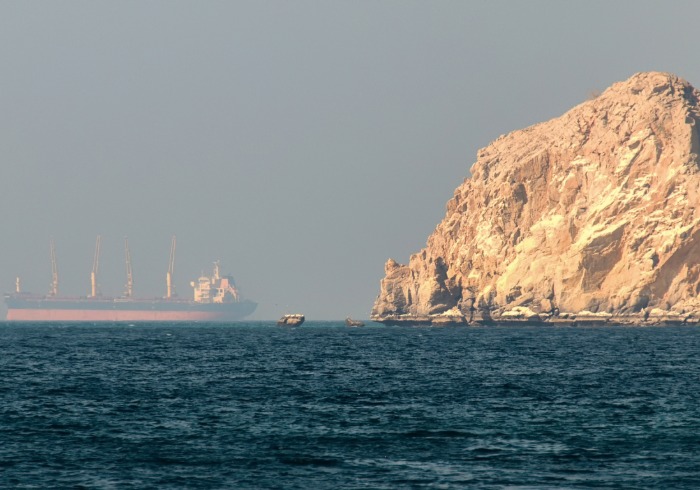
Commercial vessel traffic through the Strait of Hormuz has effectively ground to a halt following rapidly escalating conflict in the region, marine intelligence companies have said, prompting fears of a supply shock across energy markets.
Ocean carriers Maersk, MSC, Hapag-Lloyd and CMA CGM have each issued advisories warning of disruption to shipments after Iran launched a series of attacks on vessels in the Strait of Hormuz and the Gulf of Oman, in retaliation for US and Israeli missile strikes targeting its leadership and nuclear sites.
As of press time, the UK Maritime Trade Operations Centre has reported four strikes across March 1 and 2.
Maersk said on March 1 it was suspending all crossings of the Strait of Hormuz until further notice, while MSC said all vessels in the Gulf region had been routed to designated safe shelter areas.
Satellite imagery shows the strait is effectively “a no-go zone right now”, David Tannenbaum, director of Blackstone Compliance Services, told GTR, with only a single tanker making the journey north early this morning.
A report issued by marine intelligence firm Windward today said there are hundreds of vessels at anchor or holding position in the Gulf of Oman, and main tanker lanes are empty.
A small number of bulk carriers have transited the route, potentially suggesting informal tolerance for dry cargo such as food or coal, but none were sailing under EU, UK or US flags, the report said.
Energy chokepoint
Several organisations have warned that the de-facto closure of this route could have major implications for oil and gas flows.
“The Strait of Hormuz is the world’s single most critical energy chokepoint,” said market intelligence firm Kpler in a March 1 article. “Any meaningful closure… would trigger supply shocks across multiple commodity classes simultaneously.”
The strait typically carries around 20 million barrels of oil per day, or nearly a third of all seaborne crude flows, according to a client report issued by intelligence advisory Pangea-Risk today and seen by GTR.
The majority of that volume is shipped to buyers in China, India, Japan and South Korea, it said. Although Saudi Arabia, the UAE and Kuwait hold significant spare oil production capacity, bringing that oil to market is also almost entirely reliant on the Strait of Hormuz.
“The bypass infrastructure that Gulf states have developed provides only marginal relief,” Pangea-Risk said. “Any closure strands the very buffer the global oil market relies on to absorb supply shocks.”
The strait is also essential for energy flows from Qatar, which is one of the world’s top three exporters of LNG.
“Over 90% of Qatar’s LNG exports must pass through this route,” said Florence Yu, associate LNG market analyst at intelligence provider Vortexa. “If the flows are disrupted or held, Asian buyers will face the greatest exposure because 25% of Asia’s total LNG deliveries transits this point.”
Importers in China, India, Taiwan and South Korea are most at risk, Lu said. Qatar also supplies around 12% of Europe’s LNG.
“Unfortunately, there is no spare capacity in the LNG market, so the destruction on the LNG market will be immediate and immense,” she said.
The situation is exacerbated by attacks on QatarEnergy facilities in Ras Laffan Industrial City and Mesaieed Industrial City today, which prompted the company to halt production.
Vortexa chief economist David Wech added that oil products such as diesel, LPG and naphtha will also be affected by the conflict.
Other commodity flows under threat include fertiliser. Pangea-Risk said around a third of globally traded fertilisers such as sulphur and ammonia transit the strait, while Qatar, Saudi Arabia and Iran account for 25% of nitrogen fertiliser exports. Production lags mean the impact may not immediately be felt in food prices, the advisory said.
Rising costs and new risks
Law firm Kennedys warned today there could be implications in the insurance market if the situation deteriorates further.
If parties are unable to honour contractual delivery obligations because of disruptions to transit or production, there could be a spike in trade credit claims, it said.
“We may also see claims under political risk policies for forced abandonment as western companies pull their personnel out of the region and cease activities due to the conflict,” Kennedys said.
Shippers operating in the region are already grappling with insurance issues as well as rising costs.
CMA-CGM announced today it was introducing an emergency conflict surcharge of US$2,000 for 20ft dry containers and US$3,000 for 40ft containers, which followed a similar announcement from Hapag-Lloyd yesterday.
The Financial Times reported on February 28 that insurers sent notices to shipowners on February 28 cancelling their war risk cover, ahead of anticipated price hikes of as much as 50%.
“With the rise of the additional war risk premiums… we expect further upward pressure on crude tankers,” said Ioannis Papadimitriou, lead freight analyst at Vortexa. “In tandem, we expect [oil] product tanker segments to also follow suit.”
Pangea-Risk said war risk cover remains “available and priced”. However, vessels continue to face an array of security threats in the region.
Windward’s report noted that the attacks on vessels so far appear to be the result of “indiscriminate targeting”.
One vessel attacked, the Hercules Star, has a clear western profile, the report said. It is Gibraltar-flagged, Maltese-owned and operated by a Spanish company, it said.
However, another – the Skylight – has been used to transport Iranian petroleum products, was operated by a company with ties to Iranian authorities, and carried five Iranian nationals among its crew, Windward said.
“Striking this vessel strongly suggests Iran did not conduct systematic pre-strike identification,” it said.
Blackstone’s Tannenbaum added that electronic warfare, such as jamming vessels’ location signal reporting, is “intense” and is also being deployed on the Dubai side of the channel.