
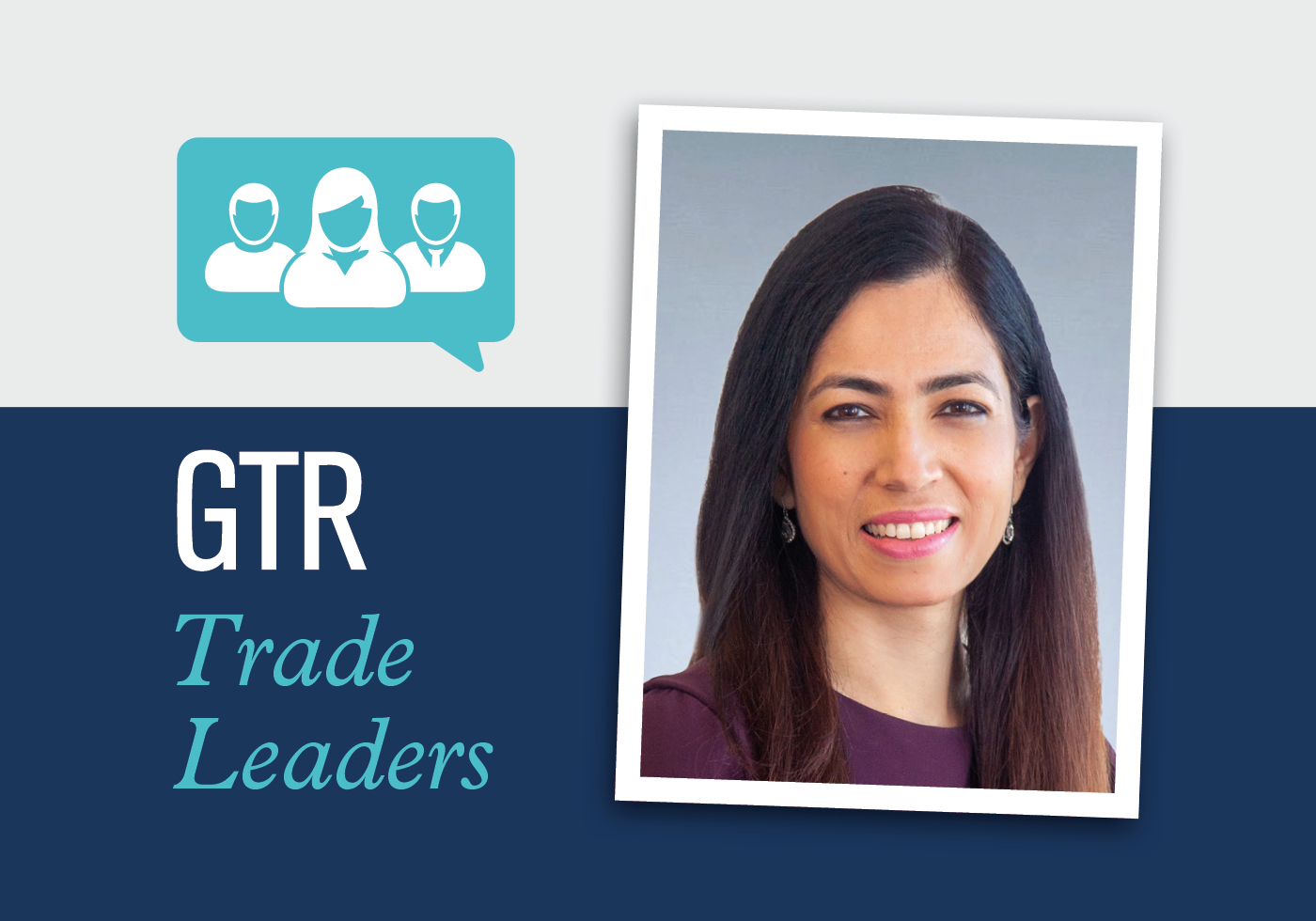
Jaya Vohra began her banking career in India before moving to the UK and joining Barclays in 2011. Now global head of trade and working capital and transaction banking account management, she has progressed through a succession of senior roles during more than 15 years at the bank.
Results-driven and focused on execution, Vohra wants the industry to move beyond short-term fixes and turn its recommendations into action. She speaks to GTR about the long road to digital trade, the potential for AI to tackle stubbornly manual processes and her new role as co-chair of the B20’s Trade Task Force.
GTR: You have now been global head of trade and working capital for a year. How has the role developed?
Vohra: We were already on a journey to lay the foundations for the business and set it up for future growth. We are now well down that path and have a globally consistent platform strategy.
Over the past year, the world has become even more disrupted, so sharpening our client focus and how we respond to clients’ needs has been key. It is not just about products or providing the right structures.
We want to be close to clients, help them connect the dots across the organisation and give them access to the right advice. At the same time, we are thinking about how to deliver a journey that is largely automated but still draws on the pockets of expertise we have across the business.
Another priority is deploying emerging technologies to support faster decisions and automate some of the traditionally manual processes in trade and working capital. Bringing AI into that story has been really exciting.
Taking on the role has also come with greater visibility and support for trade within the organisation. It has been a great year, both internally and through external engagement, but the focus now is on building a bold and ambitious plan for trade and working capital.
GTR: You have long been a proponent of innovation in trade. What guides your approach?
Vohra: My approach to product development and innovation is execution-focused. My biggest frustration with trade digitalisation is that there has been plenty of technology that could have helped accelerate innovation, but this is not simply a technology problem.
There is often a focus on what can be achieved in the next three, six or nine months – that instant gratification. My focus is on the next 10 years: how do we move the global trade landscape towards digital trade?
It is a global problem, it will take time and we need to work with stakeholders that can influence the dialogue. That is why the ICC-Barclays Trade Digitalisation Task Force, which I co-chaired, was a pivotal moment in moving towards a public-private partnership model, although we were really only scratching the surface.
Legal reform is a key part of the transition, and several countries have made progress. But much of global trade remains paper-based even where legal reform is not required. We also need to move the dial on digital customs and invoicing processes, and then leverage those legal frameworks to accelerate the wider digitalisation of trade.
GTR: The Trade Digitalisation Task Force concluded its work in 2025, having developed recommendations on regulatory reform, fraud prevention, streamlining KYC and a wider roadmap for digitalising UK trade. What have been the key takeaways?
Vohra: The task force ran for about three years and really gained momentum in its final 12 to 18 months, when the papers were published.
The broader task force supported the wider narrative and conversations, while key industry participants brought their expertise to the table to help write the recommendations. I think that is what the task force unlocked: concrete recommendations to government.
But because I am outcome-focused, the question is: what do we do with those recommendations? There are pockets of dialogue still going on, but I think there needs to be a second wave that focuses on delivery.
That is something we should pick up as part of the ICC discussions, including in the run-up to the ICC Global Banking Commission in November.
GTR: In terms of innovation in technologies, what difference could AI make to trade finance?
Vohra: Earlier technologies such as optical character recognition and machine learning operated on similar rails, but they were limited in their ability to interpret unstructured data, convert it into structured data and support meaningful decisions.
AI can help us leapfrog some of those limitations. It can help us make decisions faster and more consistently. Financial crime is one example: trade processors need to make consistently the right decisions, drawing on multiple sources of data, and AI could offer significant benefits.
It is still early, but the promise of the technology is much greater than what we had previously. Most banks – and, really, most companies globally – have spent the past year examining how AI can automate routine tasks. I expect we will begin seeing the results of those efforts over the next 12 months.
However, AI does not eliminate the paper still moving through the ecosystem. We need a two-pronged approach: use AI to turn unstructured information into structured data while continuing the shift from paper to digital trade. We cannot lose sight of that longer-term goal.
GTR: You were recently appointed a co-chair of the B20 USA 2026 Trade Task Force, which is developing business recommendations for the G20 on areas including rules-based trade, SME participation, supply chain resilience and cross-border investment. What does your role involve?
Vohra: It is very new to me, but I am loving it. The task force brings together a varied group of co-chairs from corporates, banks and organisations such as the ICC. It is supported by a broader membership group that helps develop recommendations, which the co-chairs then validate.
Those recommendations will ultimately be presented through the B20 and G20 process. There will also be engagement within the individual G20 countries.
What makes it particularly valuable is that it is not just banks and fintechs talking to one another. It brings corporates and government into the conversation, which is exactly the kind of public-private partnership we need to spur global change. It is a very interesting time in the world to be doing that work.
The US holds the G20 presidency this year and the UK will take it on in 2027, so hopefully the work will also help inform and shape the recommendations for next year.
GTR: The UK is forging new free trade agreements; what is needed to help companies benefit from them?
Vohra: Free trade agreements are significantly important, but the challenge is translating the opportunities they create to corporates in a way that is understandable to them.
I call it the commercialisation of free trade agreements: what does that actually mean, and how can we help corporates capitalise on those opportunities, whether they are new to exporting or already exporting?
That means partnering with government bodies, whether the chambers or the government itself, to bring that information to our clients more easily. More broadly, we want to support the strategic initiatives the UK government has around exports and be there as a partner and thought leader in that space.
GTR: You have worked across sales, risk and product roles in India and the UK. How has that shaped you as a leader?
Vohra: Having that 360-degree view early in your career is important. It helps me think about what trade and working capital needs to deliver for clients while also making the right risk decisions for the business, the bank and its shareholders.
Moving to the UK in 2008 without ever having visited also gave me an appreciation of countries at very different stages of growth, with different challenges, cultures and ambitions. That perspective matters when leading a global business. You have to consider local cultural nuances, the stage of development of each market and the different personal aspirations people bring to their work.
I am definitely a natural problem-solver. But my leadership journey has also been one of humility: learning to listen and respond to the wider organisation, people and our clients.
Junior colleagues in operations teach me so much about what trade and working capital is today and how we can change it for the future. That journey has evolved me in ways I did not expect.
GTR: What occupies your time outside of work?
Vohra: For me, it has been about balancing my career with bringing up my now-teenager, who has a keen interest in music. I am completely musically challenged, so two bankers parenting a child interested in the performing arts has been a fun journey. I am learning about different guitars, amplifiers and recording equipment. I have a complete dislike of social media, but you have to embrace that too.
Getting feedback from very empowered children today is also a lesson in leadership, because there is an active audience ready to tell you what it thinks. As a leader, you need to be authentic, listen and respond. There is a lot of commonality there, so I learn and apply the lessons in either direction.
Where I can find the time, I am also trying to invest a little more in my own health and personal development. But there are only 24 hours in a day.