

Changing trade flows, correspondent banking pressures and rising demands from internationally active clients are reshaping the operating environment for US regional banks. But bankers gathered at a roundtable in Florida argued that closer collaboration, strong client relationships and a willingness to innovate are helping the sector turn disruption into opportunity.
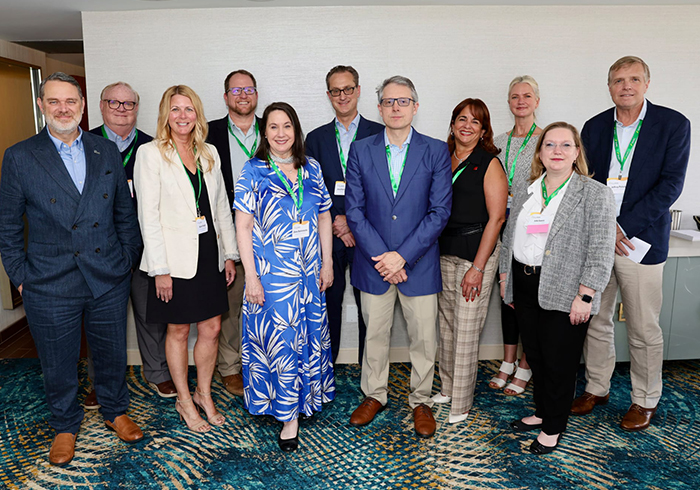
From left to right: Daniel Pinho, Paul Warfield, Karen Pinkall, Michael Babbitt, Diana Bustamante, Jonathan Heuser, TJ Raguso, Emy Ruiz, Shannon Manders, Lelia Savory, Jeffrey Peters, (not pictured Subha Srinivas)
Roundtable participants:
- Michael Babbitt, head of trade and supply chain finance origination, Synovus
- Diana Bustamante, managing director, global trade and supply chain finance, City National Bank
- Jonathan Heuser, head of trade and supply chain finance, Citizens
- Shannon Manders, editorial director, GTR (moderator)
- Jeffrey Peters, international banking director, Banner Bank
- Daniel Pinho, vice-president, operations and business management, Bankers’ Association for Finance and Trade (Baft)
- Karen Pinkall, director, global banking, FNBO
- TJ Raguso, executive vice president, director of global banking, Zions Bancorporation
- Emy Ruiz, head of global transaction banking, Fifth Third Bank
- Lelia Savory, senior vice-president, product and servicing manager, international department, First Horizon Bank
- Subha Srinivas, vice-president, operations manager, US Bank
- Paul Warfield, managing director, global advisory solutions, Huntington National Bank
US regional banks are increasingly positioning themselves as problem-solvers for internationally active middle-market clients, as geopolitical volatility, correspondent banking shifts and changing trade corridors put pressure on companies’ traditional routes to market.
During a closed-door discussion hosted by GTR at the Bankers’ Association for Finance and Trade (Baft) Global Annual Meeting in Orlando, Florida, trade and transaction banking representatives from US regional banks said the current market is less defined by any single issue than by a broader mix of geopolitical uncertainty, policy shifts and changing trade flows.

“I’d say the real issue is uncertainty, not necessarily tariffs,” said Michael Babbitt, who leads trade and supply chain finance origination at Synovus.
That uncertainty is showing up in client behaviour, transaction flows and correspondent banking relationships. Participants described clients rethinking sourcing routes, delaying commodity contracts, seeking new liquidity solutions and relying more heavily on regional banks for trade finance guidance at moments when larger institutions may be less willing or able to provide tailored support.
“Your customers need you,” said Paul Warfield, who advises corporate clients on global trade and working capital solutions at Huntington National Bank. “Through any of this stuff in our markets, with our size banks, the customers need us.”

For Jonathan Heuser, who heads Citizens’ trade and supply chain finance business from New York, that is where regional banks’ relationship model becomes particularly important. Many clients are internationally active middle-market companies with sophisticated trade finance needs, exposed to sanctions, tariffs, logistics disruption and changing supplier relationships.
Clients “really need a bank that, even if we don’t have all the answers around tariffs or where the next sanctions issue might emerge, is going to stick with them through the experience”, he said. “I do think regional banks have both the capacity to help clients and the mindset of being in those relationships for the long term, rather than walking away.”
Collaboration becomes a competitive tool
That need for practical problem-solving is also changing how regional banks work with each other.
Rather than viewing one another only as competitors, several roundtable participants described an increasingly collaborative regional bank ecosystem, particularly on issues such as correspondent banking access, relationship management application (RMA) networks and sanctions-related disruption.

Lelia Savory, who works across trade services and international banking operations for First Horizon Bank, said that collaboration with peers can be highly practical. “Some of us just call each other on the phone and say, ‘Hey, who do you use and how do you like them?’”
In one case, she said, several regional banks ended up opening accounts with the same correspondent after one recommended it to the others.
Participants also acknowledged tensions within correspondent banking relationships, with some banks expressing concern that larger international institutions can sometimes use trade flows to deepen direct relationships with underlying corporate and bank clients, effectively bypassing regional banking partners.
Others noted that regional banks are often reliant on global institutions for a broader suite of services, meaning trade finance can become tied to the wider correspondent relationship. Participants said this can leave regional banks in a difficult position when global banks are unwilling to support standalone trade business or lack the network needed to complete certain transactions.
Several suggested that strengthening regional bank connectivity was partly about preserving ownership of relationships within the middle-market segment.

Babbitt described one example from a previous regional banking gathering where a bank needed access to a particular correspondent banking channel to complete a transaction. “Somebody in the other room said, ‘Yeah, I can do that,’” he said. “Before the drinks were served at five o’clock that had been rerouted through that other bank.”
Those informal networks have helped fuel interest in CoLedger Solutions, an initiative aimed at formalising some of the correspondent connectivity and RMA networks that regional banks already share. RMAs are Swift permissions that allow banks to exchange authenticated messages with one another, making them a core part of correspondent banking and trade finance connectivity.
CoLedger Solutions is in the prototype stage, participants said, though regional banks are already collaborating informally, and the initiative is intended to help scale that connectivity more systematically. Its long-term effectiveness will depend on broader bank participation and network adoption.
Babbitt said the idea is to improve visibility of banks’ RMA networks. “I’m open to letting [other] banks know what my RMAs are, in case there’s any that would be helpful,” he said.
Diana Bustamante, who recently joined City National Bank’s trade and supply chain finance team in New York, said one of the key benefits of such an initiative is not just identifying which banks have connectivity, but being able to find the right contacts quickly enough to make a transaction work.
“What is key for me is to be able to communicate… to be able to work out the wording in advance,” she said.
Jeffrey Peters, who heads up Banner Bank’s international banking business on the US West Coast, said one longer-term ambition could be to reduce the cost and duplication of compliance work.
“The problem with setting up an RMA for a larger bank is the cost associated with doing the due diligence in KYC,” he said, asking whether a group structure could eventually help banks meet KYC requirements more efficiently.
Regional banks are already using collective channels to solve problems, increasingly through regular Baft-led discussions that bring the group together to share challenges and coordinate responses.

One example discussed during the roundtable related to disruption following US sanctions measures introduced in early 2026 that affected certain India-linked transactions and correspondent banking flows. Several regional banks said they realised during a Baft industry call that they were simultaneously grappling with uncertainty around in-flight transactions and payment processing linked to the measures, at a time when access to regulatory guidance was limited due to a US government shutdown.
Baft’s Daniel Pinho said the association helped coordinate discussions between affected regional banks and elevate the issue into a broader industry conversation involving larger institutions and multilateral organisations.
TJ Raguso, director of global banking at Zions Bancorporation, said the situation highlighted the value of coordination among regional banks during periods of disruption. “We were being harmed unintentionally by a government action,” he said. “If we were acting individually, we had less [impact], but collectively the response was rapid and effective.”
Shifts in correspondent banking
The push to collaborate comes as regional banks face a changing correspondent banking landscape.
For some, de-risking by larger institutions is a direct challenge. For others, it is creating opportunities to pick up downstream correspondent banking business from smaller institutions that need cross-border trade support.
Karen Pinkall, who manages global trade services at FNBO, said her bank sees both sides of that dynamic. It still has to manage the risk of upstream correspondent banks reassessing relationships. But it has also benefited as larger banks retreat from downstream correspondent banking.
“We’ve had a lot of growth because of our downstream correspondence,” she said. “Some banks larger than us are exiting the downstream correspondent business… and so we’ve picked up some of those banks.”
Emy Ruiz, who leads Fifth Third Bank’s global transaction banking and supply chain finance business, said the bank has also seen “wins” in downstream correspondent banking, including requests for support for letter of credit issuance, confirmations and credit insurance advice.
“At the same time, we’re seeing more middle-market and emerging market companies looking to sell receivables, and they don’t want to work with factoring companies – they want to work with their trusted adviser,” she said. “That activity is really increasing, to the point that we’ve had to revamp our minimums.”
Uncertainty reshapes client demand
Client demand is shifting alongside those changes in correspondent banking relationships.
Raguso at Zions said tariffs have not become the dominant obstacle for clients in the way many would have suspected. “It’s as much a risk as it is an opportunity,” he said. “It seems we talked about it a lot, but it’s not something that is stopping the business.”
City National Bank’s Bustamante said some New York-area clients are “really affected” by supply chain issues around disruption in the Strait of Hormuz and are having to rethink sourcing strategies.
“You do see some of our clients trying to redirect where they source their goods,” she said. “If they have to redirect, because they can’t get the shipment from that point, then they need a letter of credit, or they need guidance.”
For middle-market clients, those pressures can be harder to absorb. Ruiz said some companies “don’t have the same abilities to pass on the tariff cost to their customers as the larger companies”.
“So then we need to find solutions and ways to do different things that the larger banks are not going to do,” she said. “We need to structure transactions or give them some sense of relief, because they now have costs they need to absorb. If they increase prices, their clients are going to go somewhere else.”

Pinkall at FNBO said tariffs have become part of a wider cost and disruption story for clients.
“That tariff issue, it moved on from just tariffs to geopolitical issues,” she said. “We have a lot of grain exporters, and they’re doing great, but costs have gone up. They’re shipping from the west coast to Asia, so they’re not going through [Hormuz], but their costs have gone up because everything else has gone up.”
Subha Srinivas, vice-president and operations manager at US Bank, pointed to growing volatility in trade finance demand, particularly around commodity-related transactions.
“One day, there’s nothing coming from the client. [The next] day, we find tons of requests coming from the customer,” she said. “Managing that workflow is a bit of a challenge.”
She added that US Bank is seeing “a bit of an impact on the commodity side”, particularly around contract finalisation and pricing negotiations. “There are delays… on the pricing negotiation that’s happening with the customer,” she said, adding that the bank is also seeing less predictability in letter of credit volumes than in previous years.
Regional banks get more ambitious
At the same time, the regional bank sector itself is changing.
Several participants described institutions that are growing through acquisitions, expanding geographically, adding new product capabilities or preparing to serve a more sophisticated client base.
Synovus has merged with Pinnacle Financial Partners, with the Synovus name set to disappear under the new bank. The bank currently focuses primarily on traditional trade and does not yet offer supply chain finance, though Babbitt said he would like to bring that into the product set.
Fifth Third has recently acquired Comerica Bank, Ruiz said, making it “the ninth-largest bank of the US” and taking the institution to around US$300bn in assets.
“We want to do more globally,” she said. “Even though we’re not a global bank, our clients are global, and it’s important for us to follow the trade flows of our clients.”
Huntington is also growing through acquisitions. Warfield said the bank had made two acquisitions in recent years as part of a broader push to become a larger institution, with the second due to complete in June and expected to take Huntington to around US$290bn in assets.
Alongside that growth, Huntington over the past few years has added receivables financing and supply chain services “in a much bigger way”, supported by automation, and is now upgrading its back-office systems to prepare for digital documentation.
For Citizens, expansion is more geographic. Heuser said the bank is investing in growth markets including California and Florida, which could change the profile of its trade business by bringing in clients with exposure to markets the bank has not historically served.
Other participants described growth in terms of product and client segments. Savory said First Horizon is preparing its trade services team for a wider range of clients.
Old instruments, new pressures
The discussion also highlighted renewed demand for traditional trade products, including letters of credit and standby letters of credit.
Bustamante said she remembered earlier predictions that letters of credit were “a thing of the past”, but said that view has not been borne out. “Our expertise is still valued,” she said, while warning that documentary trade knowledge remains difficult to replace.

Ruiz agreed that experienced trade finance professionals remain hard to find. “It’s hard to find people that have that [experience],” she said. “It’s a weird skill, but a skill.”
She also pointed to the return of older instruments in some corridors. “Avalised drafts– it’s coming back,” she said. “I haven’t heard that in, like, 15 years.”
While addressing both longstanding trade finance pressures and newer disruptions, the discussion underscored the role that regional banks continue to play for internationally active middle-market companies that may sit outside the priorities of larger global institutions.
As Raguso put it: “If you added up the amount of economic impact that this group of banks has when it comes to trade, I think it’s quite an impressive number.”