


Trade resilience has deteriorated in 157 countries over the last five years, according to new research from global risk data company Verisk Maplecroft, as the world’s busiest logistics hubs have become increasingly vulnerable to shocks.
The latest Trade Resilience Index, which analysed the world’s 500 busiest ports and 50 busiest airports, found that approximately one third are exposed to a ‘high’ or ‘very high’ risk of disruption from one or more acute threats, stemming from geopolitical risk and conflict, natural hazards and domestic security.
The index measures a country’s ability to withstand shocks by assessing trade balances, diversity of trading relationships and the risk environment of key trading partners.
It found countries accounting for more than 90% of global trade face increasing levels of risk, including the US, key Asian manufacturing hubs such as Singapore, and major natural resource suppliers such as Chile, Peru, the Democratic Republic of the Congo and Saudi Arabia.
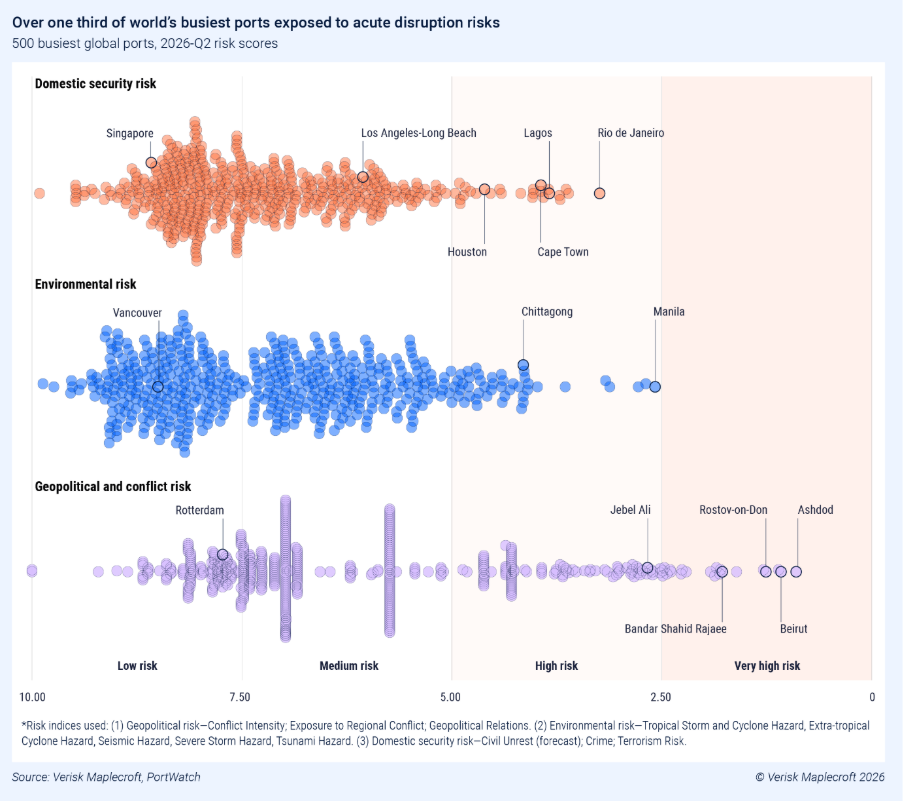
Verisk Maplecroft identified 176 of the 500 ports, which handle around 80% of global trade by volume, as ‘high’ or ‘very high’ risk for at least one of the three overarching factors measured.
“Significantly, it is the geopolitical risk and conflict pillar that stands out, with 23% of ports sitting in the two highest risk categories,” the company said.
Israel’s busiest commercial seaport, Ashdod, is rated the highest risk port in the geopolitical and conflict risk rankings, followed by Beirut in Lebanon, and Haifa, also in Israel. Jebel Ali port in the UAE and Salalah port in Oman have also taken significant hits during the US-Israel-Iran conflict.
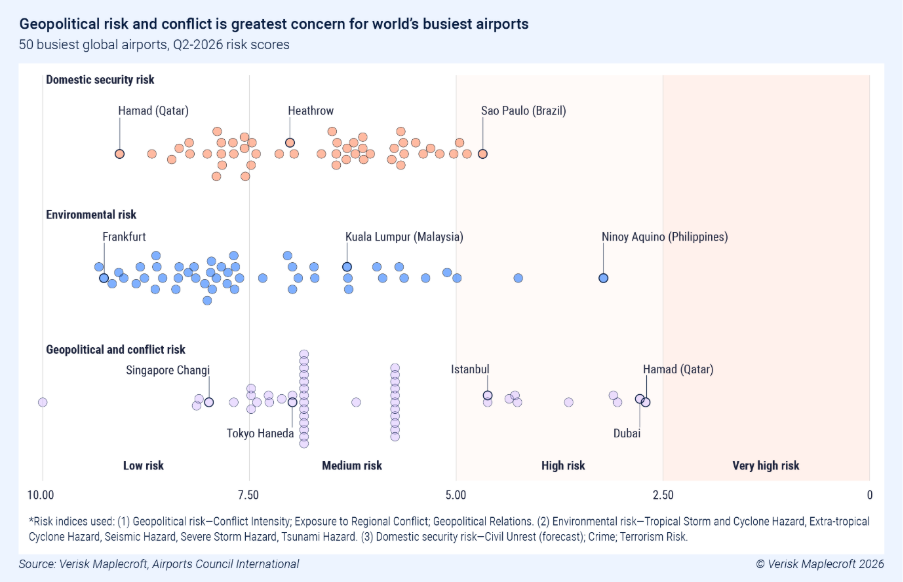
Meanwhile, as a direct result of the war, half of the 10 highest-risk airports for geopolitical risk and conflict in the latest Verisk Maplecroft assessment are in Qatar, the UAE, Saudi Arabia and Turkey.
The conflict in the Gulf has driven a 52% year-on-year decline in cargo transported between March and April 2026 across nine of the region’s major airports, according to Airports Council International. The airports are crucial for flows of costly and perishable goods, including semiconductors, pharmaceuticals, fresh produce and e-commerce shipping.
“Disruptive grey zone tactics, such as geopolitically motivated drone overflights, and direct attacks on airports have proven to pose a rising threat to their operational continuity with knock-on implications for supply chains,” Verisk Maplecroft said.
But the Trade Resilience Index findings showed that supply chain vulnerabilities extended “well beyond” the current primary chokepoints in the Strait of Hormuz, the Malacca Strait and the Panama Canal.
Outside of the Hormuz-related disruption, Verisk Maplecroft highlighted the impact of other major port closures linked to interstate or civil conflict in recent years, including Odesa in Ukraine, Tripoli in Libya, and the Port of Sudan.
Additionally, the risk data company found that while only 5% of the world’s busiest ports face ‘high’ or ‘very high’ domestic security risks – including Rio de Janeiro, Lagos, Cape Town and Houston – “half of [those ports] face elevated levels of exposure to civil unrest”.
“Even short-term disruption to operations can be significant for maritime infrastructure,” the research noted, pointing to the October 2024 three-day strike by longshoremen over wages that shut down ports on the East and Gulf Coasts of the US, with costs “running into billions of US dollars”.
Verisk Maplecroft’s analysis also showed that the global territory affected by armed fighting has more than doubled over the last five years, which means that “shocks from these factors are more likely now than in any point in recent decades and global organisations need to be prepared”.
“The question for international supply chains is no longer when your network will face a major shock, but how many it will face at once,” said Jimena Blanco, chief analyst at Verisk Maplecroft.
The research “underlines a core challenge for global supply chains: resilience can no longer be assessed only by looking at direct suppliers or obvious high-risk countries and chokepoints”, she added.
“It depends on the viability of the entire network of trade routes and the logistics hubs that connect them.”